Key Takeaways
- Beware the over 50% at fault financial cliff
Texas enforces a strict modified comparative negligence framework. Crossing the halfway mark of shared blame instantly vaporizes your entire financial recovery and leaves you empty-handed. Recognizing exactly how this mathematical threshold dictates your settlement keeps you vigilant against unfair accusations.
- Silence the friendly insurance adjuster
Corporate claims representatives undergo intense training to extract damaging statements from vulnerable drivers. Even a polite apology or a minor hesitation on a recorded phone call gives them powerful ammunition to slash your payout. Limiting your initial conversations strictly to basic facts protects the underlying integrity of your case.
- Disprove shared liability with hard evidence
Fighting false claims requires far more than your personal testimony. Securing crisp dashcam footage, tracking down independent witnesses, and consulting accident reconstruction experts systematically dismantle the insurer’s fabricated narrative. Concrete physical proof forces adjusters to acknowledge the real sequence of events.
- Consult an Austin car accident attorney
RMD Law actively shields you from manipulative corporate tactics right after a severe crash. The firm investigates the collision aggressively to minimize your assigned fault percentage and secure your rightful compensation. Relying on strategic legal advocacy stops insurance companies from successfully shifting the blame.
The Invisible Line Between a Fair Payout and Zero
You are sitting in stalled traffic on I-35 when another car slams into your rear bumper. Your neck aches. Your car is smashed. Before the adrenaline even wears off, the other driver’s insurance adjuster calls. They sound deeply concerned, asking gentle questions. They suggest you might share a tiny bit of blame for the crash. Maybe you stopped too suddenly.
Panic starts to set in. You realize a simple, offhand comment like, “I guess I hit the brakes hard,” could gut your settlement. Under the Texas modified comparative fault 51% bar rule, your financial recovery hinges on your assigned percentage of fault. In the res of this post you will discover how insurers try to manipulate fault and learn exactly how to protect your claim.
What is the Texas Modified Comparative Fault 51% Bar Rule?
When a car crash happens, blame rarely falls entirely on one person. Texas recognizes this reality. State laws use a system called comparative negligence to evaluate the actions of everyone involved. This framework dictates whether you can walk away with a financial settlement or leave empty-handed. Your final payout depends entirely on the specific portion of blame assigned to you.
You can recover damages if you are 50% or less at fault
Sharing a portion of the blame does not automatically ruin your case. You remain eligible for financial recovery as long as your share of the responsibility stays at 50% or below. The court reduces your final payout to reflect your actions. Your awarded damages drop by your exact percentage of fault. Insurance carriers know this, and do their best to minimize their financial exposure. Hiring an experienced Texas personal injury attorney can help ensure a fair assessment of liability.
Imagine a jury decides your total damages equal $100,000. They also determined you were 20% responsible for the accident. The math dictates the outcome. You lose 20% of the award and walk away with $80,000.
You recover nothing if you are 51% at fault
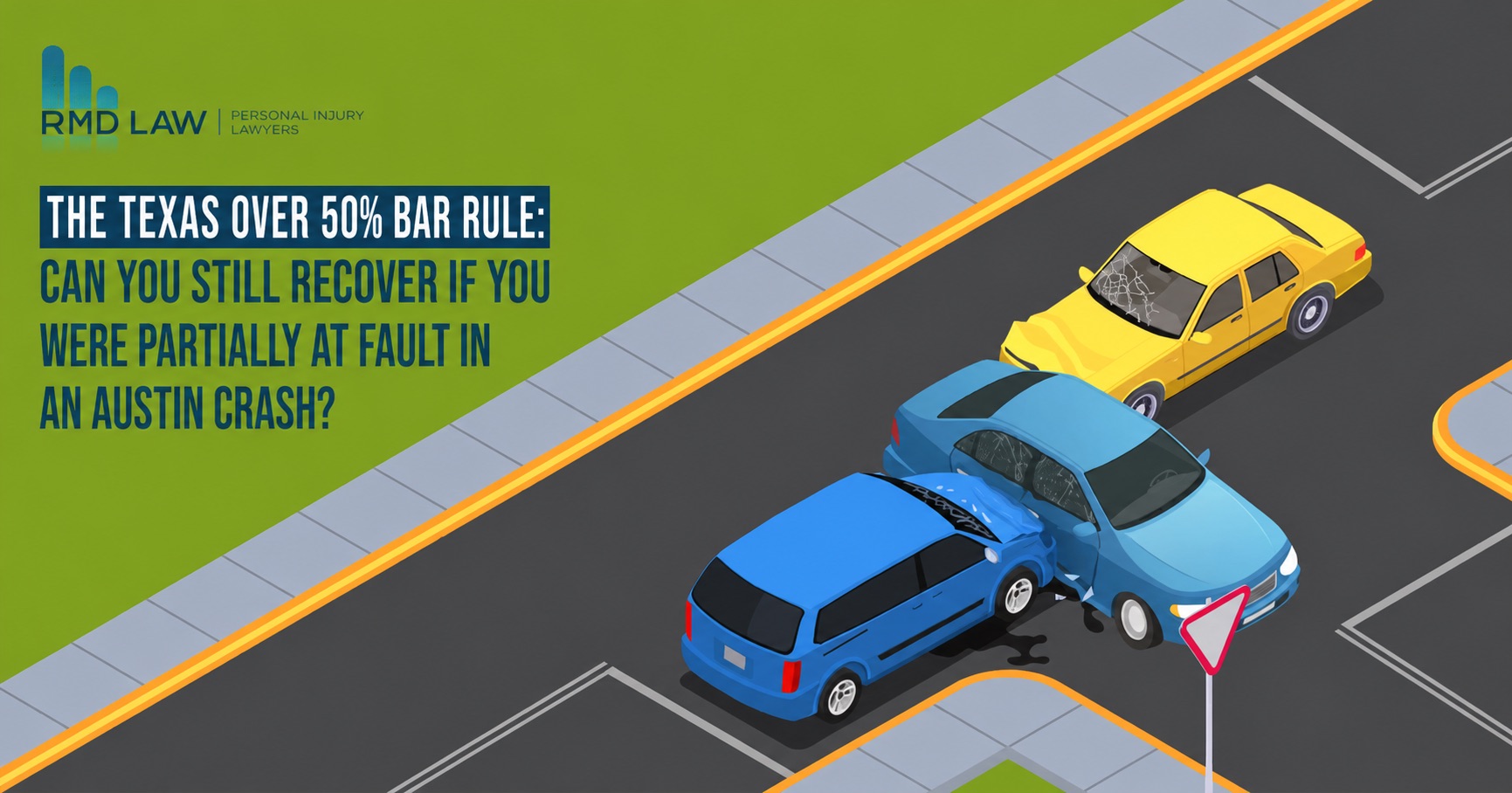
The legal landscape shifts dramatically once you cross the halfway point. This is the harsh reality of the Texas modified comparative fault rule. If an investigation or a jury finds you more than 50% responsible for the collision, you receive absolutely $0.
This rule creates a steep financial cliff. A tiny 1% shift in blame means the difference between paying your medical bills and losing the entire claim. Because the stakes are incredibly high, insurance adjusters fight ruthlessly to push your liability over that critical line. This constant battle over minor details turns standard Austin accident claims into heavily disputed cases.
How Insurance Companies Use Comparative Fault Against Austin Drivers
Insurance companies run a business. Payouts cut directly into their profit margins. Adjusters weaponize comparative fault to save their company money at your expense. They use targeted tactics to push you into accepting partial blame for the crash.
Every percentage of fault saves insurers money
Your financial recovery shrinks with every single percentage point of blame assigned to your driving. Insurers know the math perfectly. They aggressively dig for reasons to shift the responsibility onto your shoulders. Pushing your liability closer to that fatal 51% cutoff protects their bottom line and devalues your injury claim.
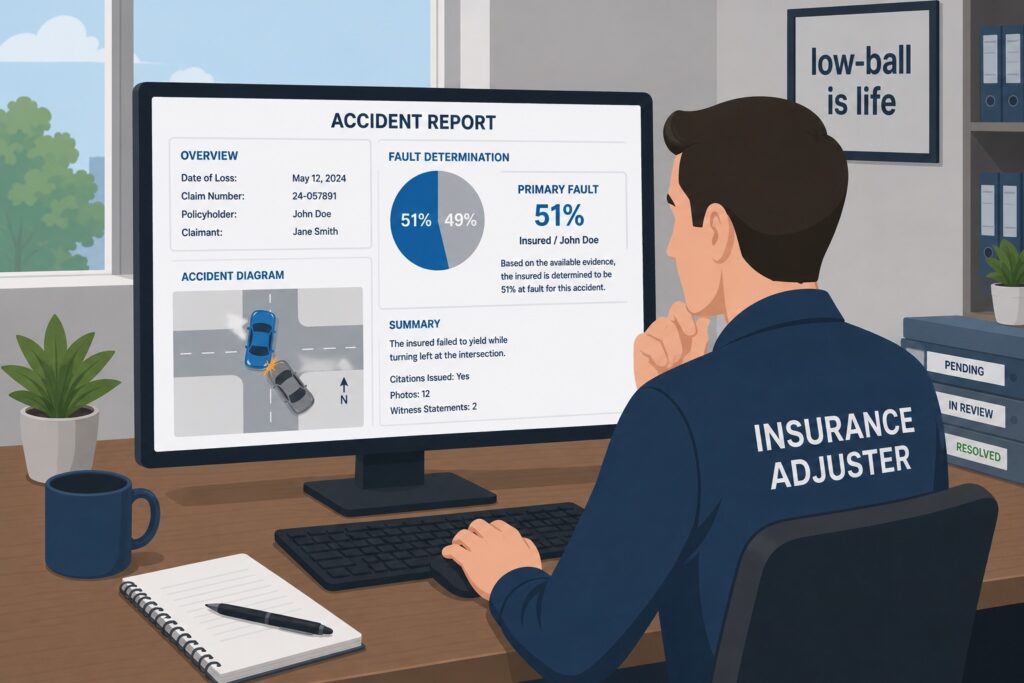
Insurance adjusters are trained to get damaging statements
The person calling from the insurance company will likely sound warm and empathetic. Do not let the friendly tone fool you. Adjusters receive extensive training to extract specific answers from you. They guide conversations smoothly to collect seemingly innocent remarks that easily shift the blame later down the line.
Recorded statements are commonly used against victims
You feel stressed, hurt, and emotionally shaken right after a wreck. Insurers exploit this vulnerable state. They ask you to record your initial phone call. Months later, they pull your scattered sentences completely out of context during settlement negotiations. A slight hesitation on tape suddenly becomes hard evidence against your credibility.
Common questions adjusters use to increase comparative fault
Adjusters phrase their questions carefully to set a trap. Your honest answers transform into legal admissions of negligence. Watch out for these specific inquiries:
- “Were you driving a little fast to keep up with I-35 traffic?”
- “Did you look away for just a second before the impact?”
- “Could you have reacted a bit sooner to avoid the crash?”
Insurers often push shared blame before the investigation is complete
You might hear allegations of shared blame within hours of the collision. Insurance companies frequently float these accusations before anyone even reviews the official police report. This early blame-shifting creates panic and doubt in your mind. The aggressive strategy pressures you into accepting a lowball settlement before you realize the actual value of your case.
How To Reduce Your Percentage of Fault After a Crash
You need hard proof to fight back when an insurance adjuster points the finger at you. Gathering the right evidence dismantles their arguments. You can actively lower your assigned percentage of fault by presenting undeniable facts.
1. Dashcam footage can strongly support your claim
A simple video recording changes everything. Dashcams capture exact lane positions and actual vehicle speeds. The footage clearly shows the color of the traffic signal at the moment of impact. When an insurer invents a false narrative about your driving behavior, a crisp video directly shuts down their claims.
2. Accident reconstruction can challenge insurance claims
Sometimes raw video simply does not exist. This situation calls for professional accident reconstruction. These specialists analyze faint skid marks and measure complex crash angles. They study the twisted metal to calculate the impact force. A reconstruction expert provides the scientific backing necessary to prove the real sequence of events.
3. Witnesses and physical evidence matter
Tangible evidence drastically reduces disputed fault percentages. You must rely on the physical details left behind at the scene. Strong cases build upon multiple layers of proof:
- Official police reports detailing officer observations
- Statements from independent eyewitnesses
- Clear photographs of the intersection and roadway debris
- Specific vehicle damage patterns showing the initial point of impact
4. Early legal representation helps protect the case
Hiring a lawyer immediately shields you from aggressive insurance tactics. An attorney steps in to manage all communication. They stop you from inadvertently making harmful statements to a clever adjuster. Legal professionals also move fast to preserve crucial evidence before a storm washes away skid marks or nearby security systems delete their footage.
Austin Car Accident Situations Where Comparative Fault Is Common
Certain types of collisions practically invite insurance companies to argue shared blame. Adjusters look at specific crash dynamics to split the liability. You need to know exactly which scenarios trigger these aggressive tactics.
Rear-end accidents involving sudden stops
You naturally assume the driver who rear-ended you holds total responsibility. Insurers see it differently. They frequently argue that you hit the brakes erratically. Heavy, congested Austin traffic creates the perfect excuse for adjusters. They claim your sudden stop contributed heavily to the collision.
Left-turn accidents at busy intersections
Intersection collisions always trigger intense finger-pointing. Both drivers usually swear they possessed the right of way. Adjusters dissect the timing of the traffic lights and scrutinize your line of sight. They love to argue that you misjudged the oncoming distance or initiated the turn without proper visibility.
Lane-change and merge accidents on I-35 and MoPac
Merging onto crowded highways like I-35 and MoPac requires precision. Assigning fault gets incredibly messy when two cars sideswipe each other. Adjusters immediately raise questions about blind spots and turn signals. They frequently label these wrecks as shared liability incidents by claiming neither driver verified a clear lane.
Distracted driving crashes
A simple glance at a screen alters your entire case trajectory. Insurers thoroughly investigate potential cellphone use after any major collision. They often demand phone records. An adjuster will quickly inflate your assigned percentage of fault if they suspect you looked away from the road for even a split second.
What To Do if the Insurance Company Says You Were Partially at Fault
When an adjuster suddenly accuses you of partial blame, you must act fast. Taking the right steps prevents you from losing your rightful compensation.
1. Avoid admitting blame
Human nature makes you want to apologize after a traumatic event. You must resist this urge. Speculating about the crash gives the insurance company free ammunition. Even a casual “I’m sorry” easily translates into a legal admission of guilt. Keep your comments strictly to the basic facts.
2. Preserve evidence immediately
Physical proof vanishes quickly. You need to gather solid documentation the moment the dust settles. Secure the following items right away:
- Photos and videos of the scene
- Dashcam footage from your vehicle or nearby cars
- Comprehensive medical records
- Witness contact information
- Official repair estimates
3. Be careful with recorded statements
You have no legal obligation to give a recorded statement to the other driver’s insurance company. You should absolutely decline their request until you obtain legal guidance. Adjusters analyze these audio files carefully. They twist your words to build strong comparative negligence arguments against you.
4. Speak with an Austin car accident lawyer early
Hiring an attorney shuts down the adjuster’s manipulative tactics instantly. A lawyer acts as an immediate shield against aggressive blame-shifting strategies. They build a solid case to keep your liability far below the dangerous 51% threshold.
How a Car Accident Lawyer Can Help Under the Texas Modified Comparative Fault
An experienced car attorney protects injured drivers from the exact tactics designed to ruin their claims. They step in to level the playing field against massive insurance corporations.
Handle communications with insurance companies
An experienced car lawyer immediately takes over all phone calls and emails from the insurance company. This decisive action prevents sneaky adjusters from tricking you into making damaging statements. Your attorney knows exactly how to push back against unfair blame allegations. They routinely block manipulative interview tactics.
Build strong evidence to minimize fault
Defeating false accusations requires rock-solid proof. Attorneys possess the financial resources to gather crucial video footage and secure expert collision analysis. They track down reluctant witnesses to record formal testimony. Compiling this undeniable evidence significantly strengthens your position during intense settlement negotiations.
Challenge weak insurance investigations
Insurance companies regularly base their initial decisions on incomplete or highly biased investigations. They rush to conclusions that conveniently protect their profits. A skilled lawyer dissects the adjuster’s report to uncover glaring inconsistencies. They force the insurer to acknowledge the actual physical facts of the crash.
Maximize compensation before fault reaches the 51% bar
Reducing your assigned percentage of blame directly increases your final financial recovery. Strategic legal advocacy preserves your claim by keeping your liability safely below the fatal 50+% threshold. Every single percentage point matters. A dedicated advocate fights for maximum compensation and protects your settlement from complete ruin.
Your Next Move Dictates Your Settlement Value
The Texas 51% bar rule drastically dictates the outcome of your claim. A minor shift in fault easily wipes out your entire financial recovery. Insurance adjusters know this math perfectly well. They use recorded statements and early blame-shifting tactics to push your liability over the edge. You must act fast to secure strong evidence and protect your rights.
Hiring a skilled car accident lawyer in Austin shields you from these aggressive insurance strategies. The legal team at RMD Law understands exactly how to dismantle false accusations and build a solid case.
Do not let an insurance adjuster steal your settlement.
Contact RMD Law for help fighting unfair comparative fault allegations and pursuing maximum compensation after a crash.
FAQs
Texas uses a modified comparative fault system. You can recover compensation after a crash only if your share of blame is 50% or less. Your final payout simply drops by your exact percentage of fault.
Yes, reaching the halfway mark eliminates your compensation. If an investigation finds you more than 50% responsible for the collision, you recover absolutely $0.
Adjusters push to increase your assigned blame to save their company money. Every percentage point of fault they pin on you directly reduces their final payout. They frequently use leading questions to extract damaging recorded statements.
You must present concrete physical evidence to dispute an adjuster’s narrative and prevent them from shifting the blame. Crucial proof includes clear dashcam footage, official police reports, independent witness statements, and professional accident reconstruction analysis.
Insurers frequently allege shared liability when drivers dispute the right-of-way. Common examples include rear-end accidents in heavy I-35 traffic, left-turn collisions at busy intersections, and highway merging accidents involving blind spots.
Never apologize or admit fault on a recorded line. Decline to provide an official statement until you secure legal representation. Contact an attorney immediately to handle communications and protect your claim from the Texas modified comparative fault 51% bar rule.

- Traumatic Brain Injury Long-Term Effects and How to Secure Your Settlement - October 20, 2026
- 2026 Updates to California E-Bike and Motorized Scooter Sidewalk Laws - October 15, 2026
- Map of Level 1 Trauma Centers in Northern California: Where to Go When Seconds Count - October 13, 2026