Key Takeaways
- Separate crash liability from injury liability
The other driver remains legally responsible for causing the collision even if your seatbelt was unbuckled. Your choice regarding a safety restraint only affects the financial calculation of your specific physical damages, rather than the blame for the crash itself.
- Force the defense to prove their claims
Insurance companies cannot simply point at an empty buckle to reduce your settlement. Under California law, they must hire biomechanical experts to definitively prove that a functioning seat belt would have prevented or lessened your exact injuries.
- Identify injuries that a seat belt cannot prevent
Severe trauma often occurs regardless of restraint usage. Structural vehicle failures, such as a crushed side door or collapsing floorboard, cause direct impact damage that a strip of polyester webbing cannot stop.
- Consult a California car accident lawyer
RMD Law dismantles the flawed science and aggressive tactics used by insurance adjusters to devalue your claim. The firm conducts thorough liability audits and cross-examines defense experts to protect your maximum financial recovery.
Why an Unbuckled Belt Isn’t a “Game Over” for Your Case
You are merging onto the 405, navigating that familiar high-speed dance of California traffic, when a distracted driver slams into your rear bumper. In the chaotic seconds of the spin, a cold realization hits: you forgot to click your belt.
Later, as you recover, an insurance adjuster suggests your claim is worthless because you broke the law. This “shame tactic” aims to make you drop your case, but it ignores the reality of personal injury litigation.
While the seat belt law in California (Vehicle Code § 27315) has pushed usage to over 96%, many accidents still involve unrestrained passengers. Defense attorneys use this fact to build the seat belt defense, a strategy designed to slash your compensation. However, being unbuckled does not hand the defendant a “get out of jail free” card. Legal recovery shifts the focus from guilt to biomechanics. Even if you were not wearing a seatbelt, the other driver still owed you a duty of care.
Understanding how California law distinguishes between the cause of the crash and the cause of your injuries is the first step toward reclaiming your case. You need to know your rights before an insurance company convinces you that you have none.
Understanding the Seat Belt Law in California and Your Rights
California Vehicle Code § 27315 technically mandates that every person in a moving vehicle wear a buckled belt. If you skip it, you might face a fine, but the civil courtroom operates differently from traffic court. Crucially, a violation of this code section does not equal “negligence per se.”
Under California law, specifically VC 27315(i), the legislature explicitly states that a seat belt violation does not automatically prove you were negligent or responsible for your own injuries. The driver who hit you had a fundamental duty to operate their vehicle safely. Their failure to do so caused the collision. Whether you were wearing a belt had zero impact on their decision to speed, run a red light, or check a text message. The law recognizes this distinction: the crash remains their fault, while the belt only enters the conversation when discussing the specific extent of physical damage to your body.
What Is the Seat Belt Defense in California?
Insurance companies use the seat belt defense as a legal tactic to shrink their payouts. They argue that by not wearing a seatbelt, you failed to “mitigate” your damages, essentially claiming you chose to let yourself get hurt. But in California, the defense cannot just make this claim and walk away; they carry a heavy burden of proof.
According to California’s Civil Jury Instructions (CACI No. 712), a defendant must prove three specific elements to successfully reduce your compensation:
- A working seat belt was actually available in the vehicle.
- A reasonably careful person in your position would have used it.
- Use of the belt would have avoided or significantly reduced your specific injuries.
This last point is the steepest hill for the defense to climb. A lawyer or an insurance adjuster is not a doctor or a physicist. To win this argument, the defense usually must hire biomechanical experts to reconstruct the crash and testify that a belt would have changed the medical outcome. If they cannot prove that the belt would have prevented your specific fracture or head trauma, the defense carries no weight.
Liability for the Crash vs. Liability for the Injury
To understand how you can still win your case, you have to look at the “two-collision” theory.
- Collision 1: The defendant’s car strikes yours. The defendant bears 100% of the liability here because their negligence, whether speeding or distracted, caused the metal to crunch.
- Collision 2: A fraction of a second later, your body strikes the interior of your vehicle. This is the only point where your choice regarding a seat belt matters.
California operates under a pure comparative fault system. This means the court looks at the math of your recovery rather than an “all or nothing” result. Here is how that breakdown typically looks in a courtroom:
- A jury determines that your total damages (medical bills, lost wages, and pain) reach a specific amount, such as $500,000.
- If the defense proves that not wearing a seatbelt made your specific injuries 20% worse, the court assigns that percentage of “injury fault” to you.
- You do not lose your right to sue; instead, the court reduces your award by that 20%. In this scenario, you still walk away with $400,000.
This framework ensures the other driver is still held accountable for the “accident fault.” A reduction in payout is not a total denial of justice.
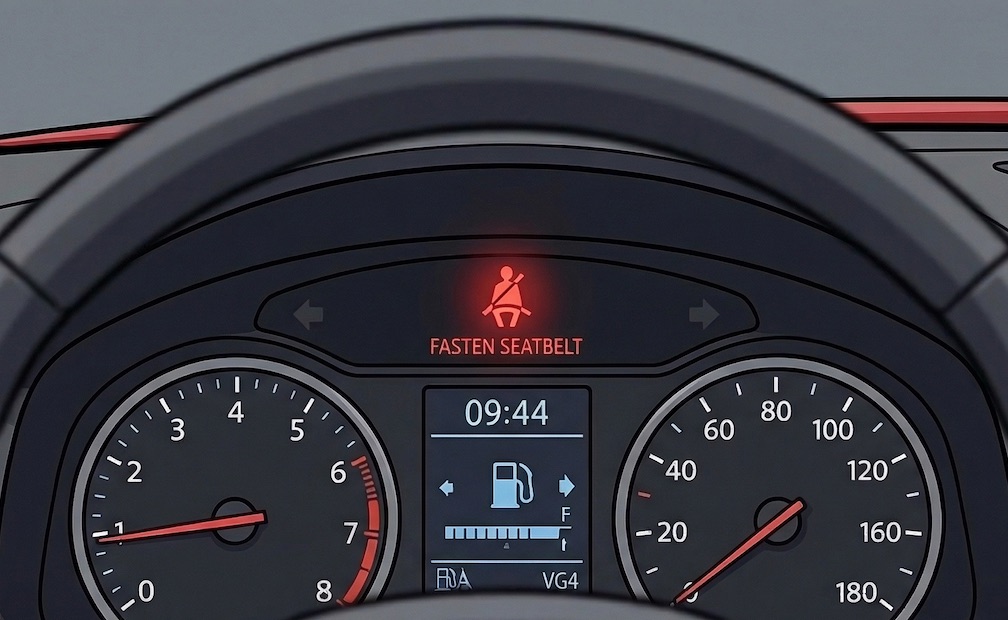
How to Prove Your Case When You Were Not Wearing a Seatbelt
Many catastrophic injuries happen regardless of whether a belt is buckled. To win, the argument must shift away from the missing strap and toward the physics of the crash. Certain impacts are so violent that a strip of polyester webbing would not have changed the medical outcome, making the seat belt defense a secondary detail rather than a case-killer.
Side-Impact and Crush Scenarios
In a T-bone accident, the point of impact is often the door right next to you. If the vehicle frame collapses inward—a “compartment intrusion”—the car itself strikes your body. While a seat belt keeps you in your seat, it cannot stop a door or a collapsing roof from crushing your ribs, shoulders, or head during a structural failure.
Leg and Internal Injuries
Lap and shoulder belts prevent ejection and chest impact with the steering wheel, but they do little to protect the lower extremities. If the floorboard collapses or your knees hit the dashboard, causing complex fractures, the fact that you were not wearing a seatbelt is often legally irrelevant to those specific, unavoidable wounds.
Data and Medical Imaging
Attorneys rely on the vehicle’s “Black Box,” or Event Data Recorder (EDR), and high-resolution medical imaging to tell the true story. This data shows the exact force of the impact and the timing of the collision. These technical details can prove that your injuries resulted from the defendant’s force and the failure of the car’s safety cage, not the absence of a belt.
How a Car Accident Lawyer in California Can Help
Fighting the seat belt defense requires more than just a basic knowledge of the law. It requires a technical response to the “junk science” often used by insurance companies to devalue a claim.
1. Challenging defense experts
Defense lawyers hire biomechanical experts to testify that your injuries were your own fault. The team at RMD Law cross-examines these experts to expose flawed data or generalized assumptions that don’t account for the specific forces of your crash.
2. Securing the vehicle
Acting quickly to file spoliation letters ensures the vehicle is preserved for inspection. If the seat belt was defective, had a faulty retractor, or the car was an older model with outdated safety tech, the defense’s argument falls apart.
3. Liability analysis
Instead of letting you guess at your percentage of fault, the car accident lawyer performs a comprehensive audit of the crash. This determines which injuries were truly unavoidable, ensuring the “shame tactics” used by adjusters don’t pressure you into a lowball settlement.
4. Negotiating against “shame tactics”
Insurance adjusters often use the seat belt law in California as a bullying tool to pressure victims into accepting pennies on the dollar. Professional representation acts as a shield, refocusing the conversation on the defendant’s reckless actions rather than your empty buckle.
5. Calculating full value
Even if a small reduction for a seat belt violation is likely, the goal is to ensure the total settlement reflects the catastrophic nature of the accident.
Don’t Let a Safety Mistake Cost You Your Future
Not wearing a seat belt is a safety mistake, but it is not a legal barrier that prevents you from holding a reckless driver accountable. The seat belt defense is a technical hurdle, not a “game over” screen for your personal injury claim. Your right to a safe road and a fair recovery does not vanish simply because you weren’t buckled up during a moment of impact.
If an insurance company has told you that you have no case, do not take their word as the final word. A skilled car accident lawyer in California can look past the shame tactics to find the data that proves your case.
If you’ve been injured and told you have no case because you were not wearing a seatbelt, contact RMD Law for a free liability analysis. We know how to fight the seat belt defense and protect your recovery.
FAQs
The seat belt defense is a legal tactic used by insurers to reduce your compensation by arguing your injuries were worsened by not wearing a seatbelt. They must explicitly prove a working belt would have prevented your specific trauma.
No. Violating the seat belt law in California doesn’t mean you caused the crash. The at-fault driver remains fully liable for the collision. While your financial recovery may be reduced under comparative fault rules, your claim is not destroyed.
California separates “crash liability” from “injury liability.” The other driver is still 100% at fault for the crash. If the defense proves an empty belt worsened your injuries by 20%, your final payout is simply reduced by that 20%.
You must prove the crash forces caused the damage. In severe side impacts or structural collapses, belts offer little protection. Attorneys use black box data and medical imaging to show that your specific injuries were inevitable regardless of a restraint.

- Traumatic Brain Injury Long-Term Effects and How to Secure Your Settlement - October 20, 2026
- 2026 Updates to California E-Bike and Motorized Scooter Sidewalk Laws - October 15, 2026
- Map of Level 1 Trauma Centers in Northern California: Where to Go When Seconds Count - October 13, 2026