Key Takeaways
- Look beyond simple driver error
Thorough investigations often reveal that intense corporate pressure, severe hours of service violations, and completely ignored maintenance schedules directly cause catastrophic highway collisions.
- Secure the critical black box data immediately
Transport companies act rapidly to erase vital electronic logging records and repair damaged vehicles, making an immediate legal demand essential to preserve your crucial evidence.
- Identify all negligent corporate parties
A severe highway collision rarely falls entirely on the operator, allowing you to demand accountability directly from the primary trucking corporation, negligent third-party maintenance crews, and careless cargo loaders.
- Partner with an experienced truck accident lawyer
RMD Law aggressively investigates complex commercial crashes to uncover hidden federal safety violations and force powerful freight operations to fund your full financial recovery.
Beyond the Driver: Proving Corporate Negligence in I-35 Truck Crashes
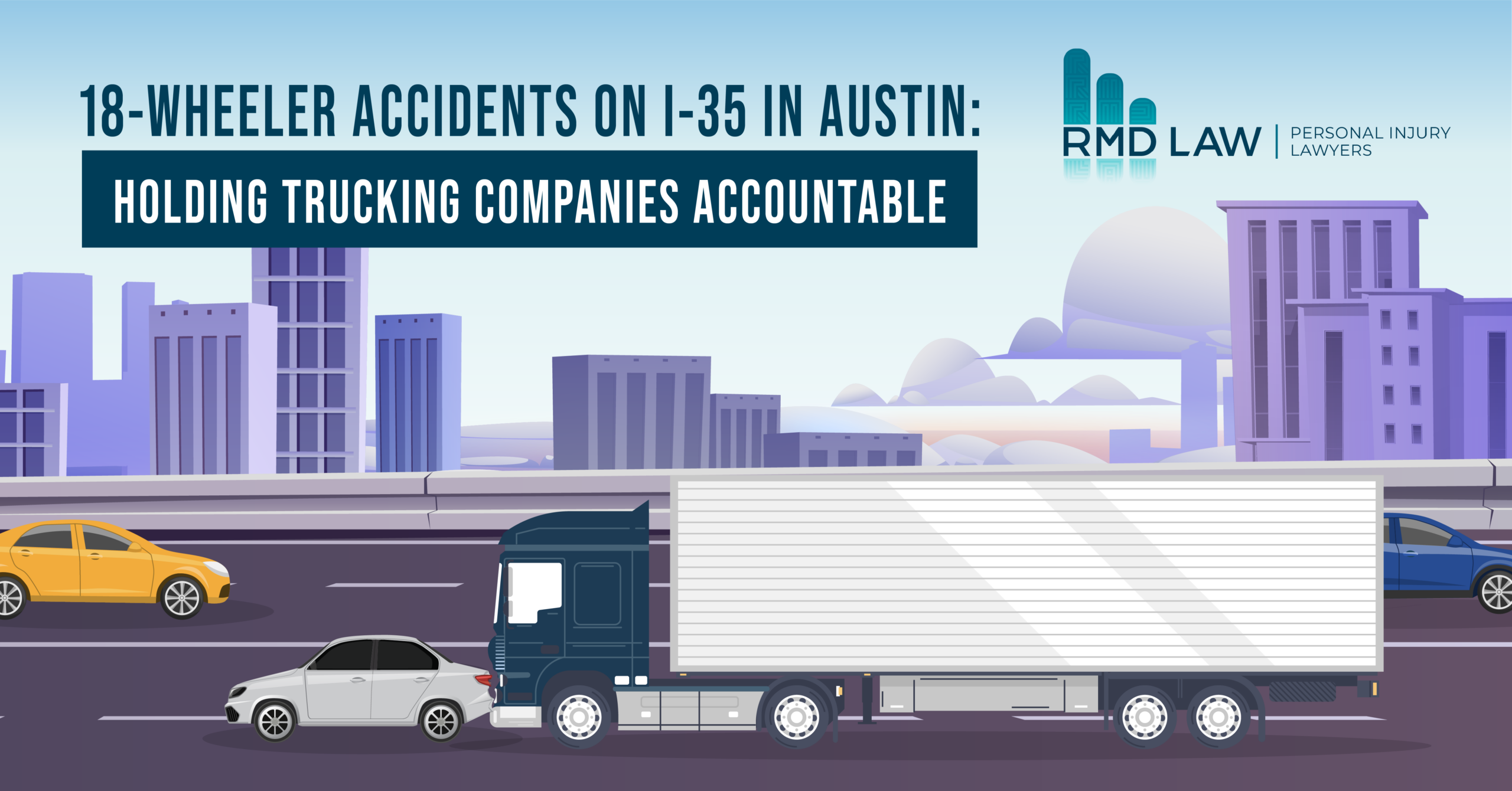
You sit in standard Austin rush hour traffic. The vehicles ahead brake sharply. You tap your brakes, but the massive rig behind you fails to stop. A sudden 18-wheeler accident shatters the afternoon commute. The violent impact severely injures you and multiple other drivers.
Most victims initially blame a simple driver mistake. A deeper investigation usually reveals a completely different story involving corporate negligence. Attorneys often uncover exhausted drivers, manipulated logbooks, ignored maintenance, and dangerous hiring practices. Freight companies running the Austin-San Antonio corridor routinely push aggressive delivery schedules that result in federal safety violations.
Understanding the real causes behind these highway collisions changes everything. You will discover why securing black box evidence matters and how injured Texans hold negligent trucking operations accountable.
Why I-35 in Austin Is One of Texas’s Most Dangerous Truck Accident Corridors
The Interstate 35 corridor essentially functions as a daily hazard course for local drivers. Commercial freight carriers and massive delivery fleets dominate these lanes at all hours. This relentless mix of passenger vehicles and heavy trucks consistently leads to serious truck accident collisions.
Heavy commercial freight traffic
I-35 operates as a primary shipping artery connecting Dallas, Austin, San Antonio, and Mexico. You share the road with a nonstop convoy of 18-wheelers transporting retail goods, heavy construction materials, and industrial cargo. The sheer volume of these massive vehicles dramatically increases the likelihood of a catastrophic crash.
Frequent stop-and-go congestion
Traffic patterns around Austin shift violently. You can cruise at full highway speed and then hit a complete standstill seconds later. A fully loaded commercial rig requires significantly more stopping distance than your passenger vehicle. When a heavy truck fails to brake in time, a single rear-end collision quickly triggers a devastating multi-vehicle pileup.
Ongoing construction zones
Concrete barriers and orange barrels dictate your daily commute. Highway expansion projects create narrow lanes, shifting traffic patterns, and virtually nonexistent shoulders. These tight constraints leave truck operators absolutely no room to safely correct steering mistakes. Nighttime construction projects also create confusing visual hazards for exhausted drivers.
High-speed driving between Austin and San Antonio
The open highway south of town changes the driving dynamic. Long stretches of asphalt encourage speeding and aggressive maneuvers. Fatigued truckers pushing their speed limits struggle to react when traffic inevitably bottlenecks near San Marcos or New Braunfels. A high-speed I-35 accident under these conditions often results in life-altering injuries or fatalities.
What Causes Many 18 Wheeler Accidents Beyond Driver Error
Many people assume a crash happens simply because a driver made a mistake. The reality often points toward dangerous corporate practices and preventable safety violations. Trucking companies regularly prioritize profits over public safety.
1. Driver fatigue from hours of service violations
Federal Motor Carrier Safety Administration rules strictly limit how long a commercial operator can drive without resting. These rules exist to keep exhausted drivers off the road. Some trucking companies completely ignore these regulations. Fleet managers pressure their drivers to skip mandatory breaks to meet unrealistic delivery quotas. Operators often forge their driving logs to hide excessive consecutive hours behind the wheel. Exhaustion destroys a driver’s reaction time and impairs crucial decision-making skills on crowded highways.
2. Distracted commercial driving
Operating an 80,000-pound vehicle demands absolute focus. Cellphones, complex GPS routing devices, and constant onboard dispatch communications easily break that concentration. A driver looking away for just a few seconds travels the length of a football field completely blind. This level of distraction directly causes devastating truck accident crashes. Taking eyes off the road in congested I-35 traffic inevitably leads to catastrophic rear-end collisions.
3. Speeding and aggressive driving
Corporate delivery systems heavily penalize late arrivals. This financial pressure strongly encourages speeding across major shipping routes. You frequently see massive rigs making unsafe lane changes, tailgating passenger cars, and merging abruptly without signaling. Excessive speed severely reduces a commercial vehicle’s ability to halt safely. A speeding truck simply cannot avoid an obstacle when traffic suddenly stops.
4. Poor truck maintenance
Commercial trucks require rigorous daily upkeep to remain safe. Worn brakes, bald tires, and failing steering components frequently trigger severe highway disasters. Some transport companies delay necessary maintenance to cut operational costs. A sudden tire blowout at 70 miles per hour quickly turns a heavy truck into a deadly projectile. Detailed maintenance records routinely reveal a long history of completely ignored mechanical problems.
5. Improperly loaded cargo
The way a crew loads a trailer directly impacts the vehicle’s stability on the road. Overloaded or uneven cargo dramatically changes the center of gravity. Loose freight violently shifts during sudden stops or sharp turns. This unexpected internal movement causes dangerous rollover accidents across multiple lanes. Improperly secured loads also increase total stopping distance and force drivers to lose control of the vehicle entirely.
Understanding Negligent Hiring and Retention in a Truck Accident Lawsuit
You might assume the driver alone holds the blame for a collision. However, Texas law often holds the employer directly responsible for knowingly putting a dangerous operator behind the wheel. Transport corporations must protect local commuters from obvious hazards.
Hiring drivers with prior safety violations
Companies must thoroughly review a commercial applicant’s driving record before offering a job. This mandatory background check should catch obvious warning signs. Prior DUI offenses, reckless driving citations, and a history of repeated crashes tell a clear story about an applicant’s habits. Ignoring these red flags actively creates preventable dangers on the highway. A company choosing to hire a known risk shares the legal blame when disaster strikes.
Employing drivers with failed drug or alcohol tests
Federal regulations strictly require routine drug and alcohol testing for all commercial operators. Transport companies face immense pressure to fill empty seats during persistent staffing shortages. Some fleet managers choose to look the other way when an applicant fails a crucial screening. Placing an impaired individual in control of a massive vehicle drastically increases the risk of a catastrophic 18-wheeler accident.
Retaining drivers with suspended or revoked licenses
A trucking company’s duty extends far beyond the initial hire date. Fleet managers must continuously monitor driver qualifications and track current licensing status. Allowing an unqualified operator to continue running freight puts everyone at risk. Discovering a suspended or revoked commercial license instantly strengthens a negligence claim against the corporation.
Failing to train commercial drivers properly
Handing someone the keys to an 80,000-pound machine requires serious preparation. Inexperienced operators frequently struggle to manage massive blind spots, calculate heavy braking distances, and navigate dense city traffic. Inadequate training turns oversized commercial vehicles into massive liabilities. This lack of preparation severely increases crash risks in narrow construction zones and congested highway corridors.
The Importance of the Truck’s Black Box Data
After a serious I-35 accident, the physical wreckage only tells half the story. The digital footprint left inside the truck’s onboard computers holds the real truth. Black box evidence and Electronic Logging Device records frequently become the most critical pieces of a lawsuit.
Black box data can reveal what happened seconds before the crash
Commercial event data recorders capture a precise digital snapshot of the moments leading up to an impact. This system records vehicle speed, sudden braking activity, throttle position, and rapid steering inputs. Crash reconstruction experts pull this data to map out exactly how the collision unfolded. You get a cold, hard mathematical breakdown of the operator’s actions instead of relying on a biased driver statement.
ELD records can expose hours of service violations
Electronic Logging Devices strictly track continuous driving hours and mandatory rest periods. These digital records rip the cover off paper-tripping schemes where operators falsify physical logbooks. ELD data frequently exposes severe driver fatigue and illegal consecutive shifts on the road. These unalterable electronic timestamps easily contradict a corporate defense team’s polished narrative.
Critical evidence can disappear quickly after an 18-wheeler accident
Transport corporations deploy aggressive defense teams to a crash scene almost immediately. They act swiftly to protect their bottom line. A heavily damaged rig might get repaired, sold for scrap, or returned to service within days. The onboard computers get wiped clean or completely destroyed during this quick turnaround. You need fast legal action to lock down this vital data before the company erases it.
Spoliation letters help prevent evidence destruction
A spoliation letter functions as a formal legal tripwire. This document legally forces the trucking company to preserve all black box data, maintenance records, and digital driver logs. Sending this specific demand halts fleet managers from conveniently deleting files or crushing the cab. An early and aggressive legal intervention secures the exact data required to prove corporate negligence.

Who Can Be Held Liable After an I-35 Truck Accident
A catastrophic crash rarely falls on just one set of shoulders. Multiple corporate entities often share the legal responsibility for the damage. You must identify every negligent party to build a strong claim.
1. Truck driver
The person behind the wheel remains the most obvious target for a lawsuit. Investigators look closely at speeding habits, signs of severe fatigue, distracted driving, and chemical impairment. Law enforcement and crash experts piece together the operator’s exact actions to prove driver negligence.
2. Trucking company
Employers frequently carry the heaviest burden of liability. Transport companies face lawsuits for unsafe hiring practices, poor direct supervision, and blatant federal safety violations. Fleet managers deliberately create dangerous environments by pressuring their staff to meet completely unrealistic delivery schedules.
3. Maintenance and repair companies
Third-party mechanics often service commercial fleets. Improper repairs and entirely skipped safety inspections directly cause devastating mechanical failures on the highway. A poorly serviced rig inevitably suffers catastrophic brake failures, tire blowouts, or sudden steering loss right in the middle of heavy traffic.
4. Cargo loading companies
Warehouse crews hold specific safety responsibilities before a truck ever leaves the dock. Overloaded trailers and improperly secured freight destroy vehicle stability. Sudden shifts in cargo force violent rollover accidents and cause operators to completely lose control of their rigs at highway speeds.
5. Truck or parts manufacturers
Sometimes the hardware itself fails completely. Defective brake lines, faulty tire treads, and broken mechanical systems directly contribute to fatal collisions. A proven manufacturing defect opens the door for a massive product liability claim against the equipment builder.
5 Injuries Common in High-Speed 18-Wheeler Accidents
Commercial vehicles dwarf passenger cars in both size and weight. This extreme physical disparity guarantees devastating outcomes during a collision. A standard sedan simply cannot absorb the kinetic energy of an 80,000-pound rig. Your body ultimately takes the brunt of this massive force.
Traumatic brain injuries (TBIs)
Violent impacts throw vehicle occupants forward with tremendous speed. Heads strike steering wheels, side windows, and deploy airbags. These brutal collisions directly cause severe concussions and permanent brain damage. Victims frequently battle debilitating memory problems and significant cognitive issues. Recovery demands years of specialized neurological rehabilitation.
Spinal cord injuries and paralysis
The crushing force of a heavy rig easily snaps and compresses the human spine. Severe structural damage to these critical nerves often leads to partial or complete paralysis. You face a suddenly altered reality involving wheelchairs and modified living spaces. Lifelong medical treatment becomes an immediate requirement. Basic daily mobility challenges completely reshape your future.
Broken bones and crush injuries
The steel frame of a passenger car collapses quickly under a commercial trailer. Rollover and underride crashes routinely trap victims inside flattened vehicles. First responders must use heavy rescue tools to extract injured drivers from the wreckage. This intense physical compression splinters ribs, shatters the pelvis, and destroys major bones in the legs and arms. These complex fractures require multiple reconstructive surgeries.
Internal organ damage
Seatbelts save lives but focus extreme pressure across your chest and abdomen during a sudden deceleration. This intense compression easily ruptures the spleen, liver, and kidneys. Severe internal bleeding presents a massive hidden danger. These specific organ injuries rarely show obvious external symptoms right away. You must seek immediate emergency medical treatment to identify and repair this internal trauma.
Severe burns and disfigurement
Commercial trucks carry hundreds of gallons of combustible diesel fuel. Highway crashes frequently rupture these large tanks and ignite massive fires. Hazardous cargo spills add toxic chemical exposure to the disaster site. Trapped victims suffer catastrophic thermal injuries from sudden fuel explosions. Medical recovery demands agonizing skin grafts, extensive reconstructive surgeries, and permanent physical scarring.
What To Do After an 18-Wheeler Accident on I-35
A sudden truck accident leaves you disoriented and in physical shock. The steps you take immediately following the collision dictate both your medical recovery and your future legal claim. You must act decisively to protect your rights against powerful transport corporations.
1. Call 911 and seek immediate medical care
Adrenaline easily masks intense physical pain. You might feel completely fine while standing on the highway shoulder. Severe internal bleeding and traumatic brain injuries frequently appear hours after the initial impact. A formal medical evaluation documents your physical condition immediately following the crash. These official hospital records build the absolute foundation of your injury claim.
2. Document the crash scene
Your smartphone serves as a highly effective investigative tool. Take clear photos of all vehicle damage, fresh skid marks, specific road conditions, and scattered debris. Capture different angles of the entire collision site before tow trucks clear the wreckage. Collect names and phone numbers from anyone who stopped to help. Witness testimony often proves crucial when corporate defense lawyers try to shift the blame onto you.
3. Avoid speaking with trucking company insurers alone
Corporate insurance adjusters will call your phone almost immediately. They sound friendly, helpful, and highly concerned about your health. Their actual job involves minimizing your financial payout at all costs. An adjuster will politely push you into giving a recorded statement. They use these recordings to twist your words and deny liability. You should never discuss the crash details with the opposing insurance company without clear legal guidance.
4. Preserve evidence related to the crash
Keep every single document connected to the collision. Gather your hospital bills, vehicle repair estimates, and personal dashcam footage. Do not throw away torn clothing or broken personal items from the crash site. A strong chain of physical evidence directly supports your account of the event. Securing these items aggressively strengthens your overall legal position.
5. Contact a truck accident lawyer quickly
Time works directly against you in commercial trucking litigation. Fleet managers and corporate investigators start building their defense the exact moment a crash happens. Crucial black box data and electronic logging records disappear incredibly fast. A rapid legal response forces the trucking company to preserve this vital evidence. An immediate investigation prevents critical data from vanishing forever.
How a Truck Accident Lawyer Can Help Hold Trucking Companies Accountable
Taking on a massive freight corporation requires immense resources. These companies employ entire departments dedicated to minimizing your payout. A skilled attorney investigates deep corporate negligence to build an airtight claim against the employer.
Launching an immediate investigation
Your legal counsel moves aggressively the moment you hire them. They immediately send a spoliation letter to lock down the fleet’s digital footprint. This formal legal demand forces the transport company to preserve crucial black box data, ELD records, and daily maintenance logs. Attorneys also deploy independent crash reconstruction experts directly to the collision site. These specialists map the physical wreckage and calculate precise vehicle speeds to prove exactly how the truck accident occurred.
Identifying FMCSA safety violations
Federal Motor Carrier Safety Administration rules exist specifically to prevent highway disasters. Your lawyer methodically audits the driver’s Hours of Service records and cross-references them with GPS data and fuel receipts. This intense scrutiny easily uncovers falsified logs and proves severe driver fatigue. A thorough review of internal company policies frequently exposes a long history of completely ignored mechanical maintenance requirements.
Proving corporate negligence
Finding the true fault means looking past the driver and examining the corporate boardroom. Attorneys subpoena employment files to prove negligent hiring practices and dangerously poor supervision. They demand access to internal company communications to expose unsafe delivery expectations. Subpoenaed emails and dispatch logs routinely show fleet managers actively pressuring exhausted drivers to break federal safety laws.
Calculating long-term damages
A catastrophic collision instantly destroys your financial stability. Lawyers work with medical and economic specialists to calculate your exact future healthcare costs. They thoroughly assess your lost earning capacity to ensure you survive financially if you cannot return to your previous career. Your legal team also demands full financial compensation for your extreme physical pain, severe emotional trauma, and any permanent physical disabilities.
Negotiating or litigating against trucking companies
Freight corporations possess massive defense budgets. They deploy aggressive legal teams to fight high-value injury claims ruthlessly. Your attorney counters this corporate pressure during intense settlement negotiations. If the opposing insurance company refuses a fair payout, a prepared trial lawyer takes the fight directly to a judge and jury. Litigating the case publicly forces the negligent corporation to answer for the damage it caused on Austin roads.
Level the Playing Field Against Freight Giants
A devastating crash on I-35 rarely stems from a single careless mistake. Freight corporations frequently cause these hazards through unsafe hiring practices, severe hours of service violations, and completely ignored maintenance schedules. You must recognize that essential black box data and critical crash scene evidence vanish rapidly after a collision. Securing a fair recovery requires aggressive legal action and independent crash reconstruction experts to fight powerful insurers.
You do not have to face corporate defense teams alone. The legal professionals at RMD Law understand how to expose hidden safety violations and hold negligent transport companies completely accountable. Partnering with a skilled Austin truck accident lawyer ensures your claim receives the immediate investigation it absolutely demands.
Contact RMD Law today to secure the experienced legal guidance you need to protect your rights and demand full compensation.
FAQs
The I-35 corridor handles massive freight volumes alongside constant stop-and-go congestion, forcing heavy trucks into frequent emergency braking situations. Ongoing construction and high-speed limits between Austin and San Antonio leave zero room for error, leading to frequent truck accidents.
While driver error occurs often, many collisions stem from corporate negligence, such as violating federal hours-of-service limits and ignoring vehicle maintenance. Trucking companies often prioritize unrealistic delivery deadlines, forcing drivers to operate while exhausted or distracted.
You can often hold the employer liable under the legal concept of negligent hiring if they put an unsafe driver on the road. This applies if the company ignored a driver’s history of failed drug screenings, multiple traffic violations, or operating with a revoked license.
A black box captures critical data points like speed, braking, and steering inputs in the seconds before an impact. This data provides objective proof of how an I-35 accident occurred, preventing the trucking company from hiding the truth behind biased statements.
You must act immediately because trucking companies often destroy or repair vehicles shortly after a crash to erase evidence. Sending a formal spoliation letter through your attorney is the only way to legally force the company to preserve ELD records and onboard computer data.

- Traumatic Brain Injury Long-Term Effects and How to Secure Your Settlement - October 20, 2026
- 2026 Updates to California E-Bike and Motorized Scooter Sidewalk Laws - October 15, 2026
- Map of Level 1 Trauma Centers in Northern California: Where to Go When Seconds Count - October 13, 2026