Key Takeaways
The California statute of limitations personal injury sets strict filing deadlines that control your right to bring a claim in California.
- Most personal injury cases must be filed within two years under California law, usually starting on the date of injury.
Government-related claims follow a shorter deadline than standard injury cases.
- Claims against cities, counties, or state agencies often require action within six months under the Government Claims Act.
Missing a filing deadline can permanently block your ability to recover compensation.
- Courts rarely allow late filings, even when injuries and evidence are strong.
Exceptions exist, but they apply only in specific cases and require proof.
- The discovery rule and tolling for minors or incapacitated individuals may extend deadlines.
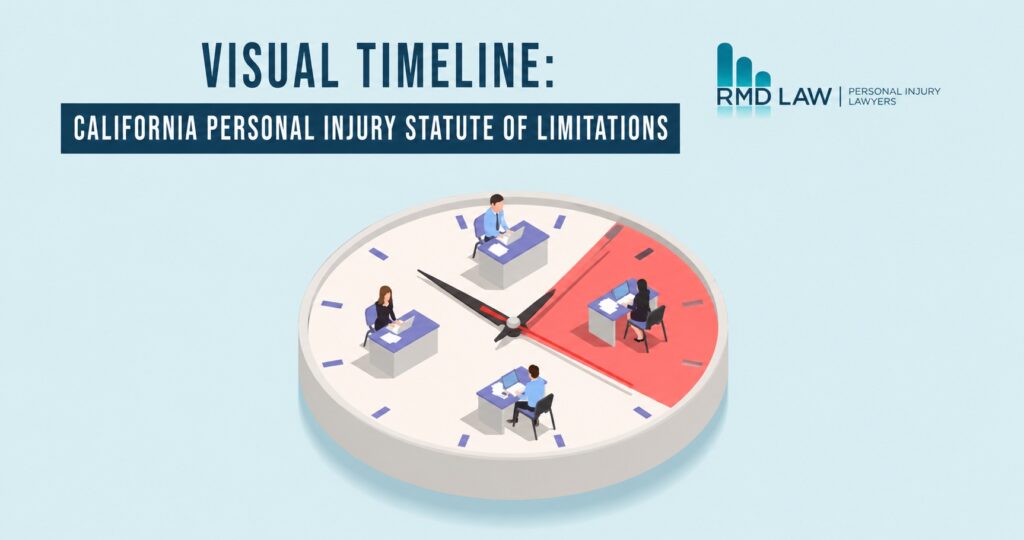
Visual Timeline: The California Personal Injury Statute of Limitations
California’s personal injury claims run on strict timelines that shape every stage of the case. The California statute of limitations personal injury rules determine how long you have to file, and missing these deadlines can affect your right to recover compensation.
Many injured people slow down because they’re focused on recovery, medical appointments, or insurance follow-ups. However, legal deadlines keep moving.
Standard filing rules apply to most cases, while government-related claims follow shorter timelines. Once these deadlines pass, courts rarely allow exceptions. Some narrow protections apply in specific situations, such as delayed discovery of injury or tolling for minors and incapacitated individuals, but these require strong proof.
This infographic clearly breaks down California’s filing deadlines so you can understand where your case stands and what time-sensitive steps may apply to you.

Two-Year Statute of Limitations Under California Law
California gives most injured people a two-year window to file a lawsuit under California Code of Civil Procedure §335.1. This rule dictates the timeline for your personal injury claim. If you miss it, courts usually won’t hear your claim, no matter how strong the evidence looks.
The clock typically starts on the date the injury happens. In rare situations, the clock may start later if you can’t reasonably discover the injury right after the accident.
This deadline runs quietly in the background while you deal with recovery. You might still be in treatment, talking to insurance adjusters, or figuring out the full extent of your injuries—but the legal timeline keeps moving. Most claims tied to the California statute of limitations personal injury framework fall into this two-year rule, which makes early action critical.
Common examples include:
- Car and motorcycle collisions on California roads
- Slip and fall injuries in stores or on private property
- Dog bites and premises liability incidents
- General negligence cases where someone fails to act with reasonable care
Delays risk the deadline and weaken your evidence. Even when liability seems obvious, timing shapes how strong your claim looks when it reaches negotiation or court. Security footage may get overwritten. Witnesses forget details. Property conditions change after repairs. Insurance companies often use that gap to challenge your version of events.
Government Claims: Six-Month Deadline
Some injury cases move under a very different timeline when a government agency is involved. Under the California Government Claims Act (Gov. Code §911.2), you often have just six months to act before you lose the ability to pursue compensation.
This rule applies when your injury involves a public entity, such as a city, county, or state agency. It also includes situations in which a government employee caused harm while performing official duties, or where unsafe public property played a role.
Before you can file a lawsuit, you must first submit a formal government claim. It initiates the administrative review process and gives the agency the opportunity to accept or deny responsibility.
Situations that often trigger this deadline include:
- Crashes involving government vehicles or employees
- Dangerous public sidewalks, roads, or parks
- Falls caused by poorly maintained public property
- Incidents involving public transportation systems
Once the claim is filed, the agency reviews it within a set period. If they reject or don’t respond to it, you then move forward with a lawsuit. Missing this six-month deadline usually ends the claim. The legal system treats these timelines as strict conditions, not flexible guidelines.
This is one of the most overlooked parts of the California statute of limitations personal injury process, especially because many people assume they still have the standard two years.
Exceptions That May Extend Filing Deadlines
California law allows limited exceptions to pause or delay the statute of limitations, but courts apply them carefully and require strong supporting facts.
One of the most common exceptions is the discovery rule, when you don’t immediately realize you were injured or when the harm develops over time. Medical complications, delayed diagnoses, or hidden injuries can sometimes shift the start of the filing period.
Another important exception involves tolling protections, such as when the injured person is a minor or legally incapacitated at the time of the incident. In these cases, the clock may not start until the legal disability ends.
Examples of situations where exceptions may apply:
- A medical condition discovered months after an accident
- A child injured before turning 18
- An individual unable to understand or act due to incapacity
- Latent injuries that appear long after the incident
Even when these rules apply, they don’t guarantee extra time. Courts will need clear proof showing why the delay was justified. Insurance companies also challenge these claims, especially when evidence becomes harder to verify.
How RMD Law Can Help Personal Injury Victims
Personal injury deadlines move quietly while you focus on healing, but your options will narrow down fast. A legal team helps you stay ahead of deadlines while building a case that holds up under insurance and legal scrutiny.
1. Evaluate filing deadlines
We review the facts of your case and identify the exact statute of limitations that applies. We check whether your claim falls under the standard two-year rule, a six-month government claim, or an exception.
2. Preserve critical evidence
We move quickly to secure key evidence before it disappears or gets altered. This can include accident reports, medical records, photos of the scene, surveillance footage, and witness statements.
3. Manage filing requirements
Your attorneys prepare and file all required legal documents on time. We file your court documents and necessary government claims to protect your case from procedural errors.
4. Handle insurance and defense tactics
Insurance companies often look for ways to reduce payouts or shift blame, especially when deadlines are close. Your legal team responds with documented facts, medical evidence, and liability analysis to push back on low or unfair settlement offers.
5. Guide the legal process
We explain every step of the legal process in plain terms. You stay informed of what’s happening and what comes next, so you don’t have to navigate the process alone.
When Time Decides the Outcome
California’s filing deadlines don’t adjust for recovery time, confusion, or delays in dealing with insurance. The two-year statute of limitations and the six-month government claim are strict cutoffs, and missing either can block your right to compensation.
Some cases qualify for exceptions like the discovery rule or tolling for minors and incapacitated individuals, but these protections don’t apply automatically. Courts require clear evidence, and insurers often challenge its use.
What matters most is timing. Early documentation of your injuries, the scene, and witness accounts can protect details that become harder to prove later. The sooner you act, the more control you keep over your case.
If you or a loved one has been injured in a personal injury incident in California, contact RMD Law today for a free consultation. Our experienced personal injury lawyer can help you understand your deadlines and protect your right to pursue compensation before time runs out.
FAQs
Most personal injury cases in California must be filed within two years from the date of injury under Code of Civil Procedure §335.1. If you miss this deadline, you usually lose the right to file a lawsuit and recover compensation.
The clock usually starts on the date of the injury. In limited situations, it may begin when you reasonably discover the injury, such as with delayed medical conditions or hidden harm.
You typically must file a government claim within six months before you can sue a city, county, or state agency. Missing this deadline may prevent you from pursuing compensation.
Yes, but only in specific situations. The discovery rule or tolling may extend deadlines for minors or individuals who could not reasonably discover their injury or act within the required time.
Missing the statute of limitations usually means your case will be dismissed, even if your injuries are severe or clearly caused by someone else’s negligence. Courts rarely grant exceptions once deadlines have passed.
Early legal help protects your rights, preserves evidence, and ensures all deadlines are met. A lawyer can also identify whether exceptions apply and help you build a stronger claim from the start.

- School Zone Pedestrian Accidents in California: Who’s Liable? - September 17, 2026
- Two Roads, 76 Deaths: New Data On Fresno County’s Most Dangerous Roads - September 15, 2026
- Why Wrong-Way Crashes Are Increasing in Orange County at Night - September 10, 2026