Key Takeaways
A car black box serves as an objective, unbiased witness
- A car black box, or event data recorder (EDR), captures critical telemetry like speed, braking, and seatbelt use that is free from human error or bias.
Digital evidence dismantles false narratives from at-fault drivers
- EDR data provides digital certainty to challenge dishonest claims about speed and braking, often carrying more weight in court than a police report.
Fragile crash data requires immediate legal preservation
- Insurers may quickly destroy vehicles, or data may be overwritten after a few drives, making it vital to act urgently to secure evidence.
Formal legal procedures ensure evidence admissibility
- Extracting data requires certified technicians and legally binding spoliation letters to maintain the chain of custody and prevent the destruction of a totaled vehicle.
Urgency is the first step toward clarity and accountability
- Securing a car black box accident record immediately after a crash helps shift fault determinations and strengthens your claim for fair compensation.
Car Black Box Accident Evidence: How Event Data Recorders Prove Fault
Car accident claims in California frequently devolve into “he said, she said” disputes where at-fault drivers lie about their speed or driver behavior. This emotional toll weighs heavily on you when you know what happened but lack the immediate proof to stop a dishonest narrative.
Early police reports often rely on these incomplete statements or initial assumptions at the scene rather than a deep technical analysis. Fortunately, modern vehicles now include built-in digital crash collection systems that objectively confirm or challenge competing versions of events.
This article breaks down what event data recorders are, how they capture evidence in an accident, and the legal steps required to preserve this data before it disappears forever.
What is an Event Data Recorder (EDR)?
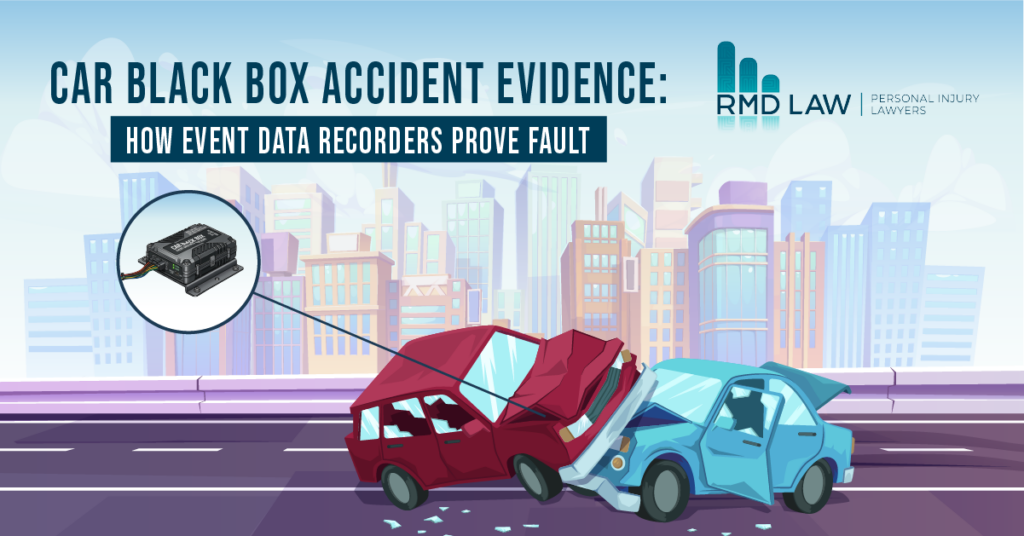
An event data recorder (EDR) is a built-in crash data module typically integrated into a vehicle’s computer system, most often within the airbag control module. Commonly referred to as a “vehicle black box,” it doesn’t continuously record driving behavior or audio but instead operates in the background and activates only during specific crash events.
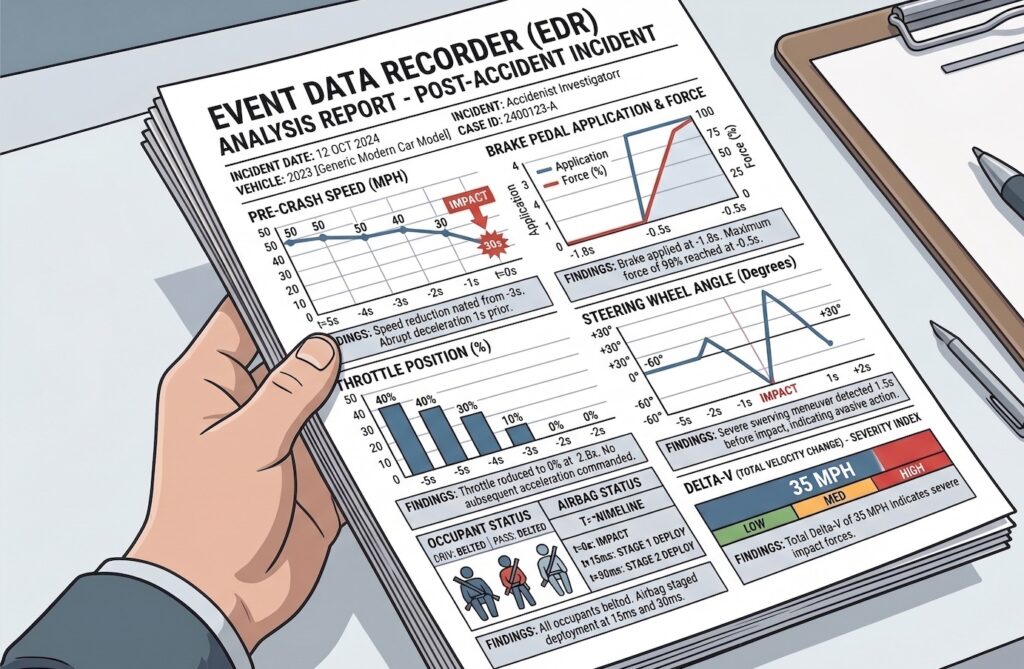
When a trigger event occurs—such as sudden deceleration or airbag deployment—it captures a short snapshot of vehicle data covering the seconds immediately before, during, and sometimes after a collision. This objective data includes:
- Vehicle speed at one-second intervals leading up to the crash.
- Brake application, recording exactly when the driver hit the pedal and with how much force.
- Throttle position, revealing if the driver was accelerating or had their foot off the gas.
- Steering wheel angle, which identifies sudden swerving or evasive maneuvers.
- Seatbelt status for all occupants and the precise timing of airbag deployment.
- Delta-V, which measures the total change in velocity to indicate the true severity of the impact forces.
Housed within the airbag control module (ACM) in a protected area of the vehicle, these devices have been voluntarily installed in most passenger cars and light trucks since the early 2010s. In legal cases, this information provides unbiased, time-stamped evidence to help reconstruction specialists determine exactly how a collision occurred.
How EDR Data is Used to Contradict False Police Statements
Police reports are essential, but they often rely on biased witness statements and an officer’s on-scene observations. Here’s how event data recorders can help challenge inaccurate or dishonest claims:
1. Disputing speed-related claims
A driver may claim they were obeying the 30-mph speed limit, but EDR data can provide indisputable proof they were traveling at 55 mph just seconds before impact. This digital certainty helps establish negligence or reckless driving that a “he said, she said” argument might miss.
2. Verifying braking behavior
At-fault drivers often claim they tried to stop, but their brakes failed, or you “came out of nowhere”. EDR data reveals exactly when—or if—the brake pedal was pressed and with what degree of pressure, often proving that the driver never attempted to avoid the collision.
3. Reconstructing the crash timeline
Forensic analysts use the EDR’s second-by-second narrative to determine exactly what the vehicle was doing in the critical moments before impact. This timeline clarifies driver behavior, such as whether cruise control was engaged in heavy traffic or if steering inputs indicate panic and distraction.
4. Clarifying inconsistencies in early reports
Initial police reports may assign fault based on incomplete statements. If the hard data from a car black box contradicts that early narrative, the digital evidence carries more weight in a legal setting because it’s free from human error or intentional deception.
5. Supporting accident reconstruction analysis
Engineers use EDR telemetry to create scientifically accurate animations of the crash. These visuals help explain complex dynamics to a jury or insurance adjuster in plain language, making it much harder for insurers to dismiss your injuries.
6. Establishing fault in contested liability cases
In states like California that use comparative negligence, insurance companies will look for any reason to shift a percentage of fault onto you to reduce your payout. Proving you were driving within normal limits through your own vehicle’s data protects you against unfair allegations and helps hold the at-fault party accountable.
Legal Process of Extracting EDR Data and the Risk of Evidence Loss
Navigating the legal path to secure crash data is a race against time and procedural hurdles. While the data is objective, getting it into a courtroom requires strict adherence to privacy laws and forensic standards to prevent it from being thrown out.
1. Legal access to EDR data
EDR data is generally accessible only with the vehicle owner’s consent, a valid legal authorization, or a court order, such as a subpoena. Unauthorized access may violate privacy protections, including federal regulations governing vehicle data.
2. How EDR data is extracted
Extraction requires specialized diagnostic tools, such as the Bosch Crash Data Retrieval system, which connects directly to the vehicle’s airbag control module or onboard diagnostic port. Certified technicians must handle the process to avoid corruption or incomplete data capture.
3. Chain of custody and legal admissibility
For EDR evidence to be used in litigation, a clear chain of custody must document every step from extraction to presentation in court. Any gaps or improper handling can result in the data being excluded as unreliable or unauthenticated.
4. What spoliation of evidence means
Spoliation refers to the destruction, alteration, or failure to preserve relevant evidence after a legal duty to retain it arises. Courts may impose penalties or allow juries to infer that missing evidence would have been unfavorable to the party responsible.
5. How totaled vehicles lead to lost data
When a vehicle is declared a total loss, it may be quickly moved to salvage or dismantling. If it’s destroyed before the EDR data is preserved, critical crash evidence can be permanently lost, weakening or jeopardizing a claim.
How RMD Law Can Help Car Black Box Accident Victims
Navigating the aftermath of a high-stakes collision can be exhausting, especially when the other driver is dishonest about their role in the crash. RMD Law provides the technical and legal resources needed to turn the tide in your favor.
1. Immediate evidence preservation strategies
We act with urgency to send legally binding spoliation letters to insurance carriers, tow yards, and salvage facilities. This prevents the vehicle from being destroyed and secures the data before it is overwritten.
2. Coordination with accident reconstruction experts
Raw data looks like confusing code and charts that are useless in a courtroom. We collaborate with qualified forensic specialists who translate this telemetry into a clear, factual narrative that a judge or jury can easily understand.
3. Handling insurance companies and disputes
Insurance adjusters often use their own experts to challenge your claim or downplay the impact of severity. Our team uses the car black box telemetry to dismantle these defenses and counter lowball offers with objective proof.
4. Building a strong, evidence-backed case
With knowledge of the exact speed, braking, and Delta-V (impact force), we protect you against unfair allegations of comparative fault. This technical evidence strengthens our hand during settlement negotiations and litigation.
5. Guidance through complex legal procedures
We handle the heavy lifting—from securing court orders for data retrieval to managing strict California deadlines. Our goal is to provide clarity and authoritative representation so you can focus entirely on your physical recovery
Securing the Truth After a Crash
Digital telemetry from event data recorders has transformed accident investigations by providing objective, time-stamped proof of what happened before impact. This data serves as your strongest shield against at-fault drivers who provide dishonest statements to the police. However, this proof is fragile and easily lost.
If you wait too long to act, the data may be overwritten, or the entire vehicle could be destroyed in a salvage yard, erasing your best chance at accountability. Securing this information requires immediate legal action and the expertise of a qualified car accident lawyer, so that your data is extracted correctly and remains admissible in court.
If you were involved in a car black box accident, acting with urgency is the first step toward building a defensible case. Contact us today to schedule your free case evaluation.
FAQs
An event data recorder (EDR) is a module integrated into a vehicle’s computer that captures technical data immediately before and during a crash. Often called a car black box, it provides an unbiased snapshot of vehicle telemetry to help reconstruction experts determine exactly how a collision occurred.
Yes, event data recorders provide objective digital evidence that often carries more weight than contradictory witness statements or incomplete police reports. Because the data is based on physics and computer measurements, it can definitively prove you were traveling at the speed limit or took appropriate evasive action.
Extracting data from a car black box accident requires certified technicians using specialized hardware, like the Bosch Crash Data Retrieval tool, to create a perfect digital image of the file. This process ensures the evidence remains unaltered and adheres to strict chain of custody standards for use in court.
Spoliation is the intentional or negligent destruction or alteration of evidence relevant to a legal case. If an insurance company quickly crushes a totaled vehicle containing EDR data after being notified of a claim, a court may sanction them for destroying critical proof.
Standard EDR data is fragile; in some vehicles, it may be overwritten after just a few drives or 250 ignition cycles. In commercial trucks, this data is often lost within 30 to 45 days. This short window makes it vital to send a formal preservation letter immediately after the crash.
While you own the EDR data, accessing it requires specialized equipment and formal legal notices to ensure the vehicle isn’t destroyed by a salvage yard. A car accident lawyer acts quickly to secure the vehicle and coordinates with forensic experts to interpret the raw telemetry for your case.

- Traumatic Brain Injury Long-Term Effects and How to Secure Your Settlement - October 20, 2026
- 2026 Updates to California E-Bike and Motorized Scooter Sidewalk Laws - October 15, 2026
- Map of Level 1 Trauma Centers in Northern California: Where to Go When Seconds Count - October 13, 2026