Key Takeaways
- Eliminate the “he-said-she-said” ambiguity
A clear video clip directly contradicts common insurance excuses like the “sudden dart-out” defense. This unbiased visual record definitively establishes your visibility, the approaching vehicle’s speed, and who truly held the right-of-way at the time of the crash.
- Beat the automatic deletion clock
Tech companies routinely wipe cloud servers to cut storage costs. You must track down these recordings within days of your collision before Ring or Nest systems permanently overwrite the exact files you need to prove your claim.
- Secure neighborhood evidence legally
Courts allow the use of private security recordings of public streets as long as you obtain them properly. Respectfully ask homeowners for specific timeframes and always preserve the original file metadata without altering the video in any way.
- Consult a California pedestrian accident lawyer
RMD Law quickly deploys investigators to canvas local neighborhoods and issue formal preservation letters. The firm authenticates digital evidence and shuts down aggressive insurance tactics to pursue your maximum financial recovery.
When Drivers Lie, Residential Security Cameras Don’t: Proving Your Pedestrian Injury Claim
You cross a quiet residential street in Los Angeles County. Out of nowhere, a vehicle strikes you. As you wait for help, you hear the driver tell the responding officer you “darted out.” Frustration sets in immediately. Suburban pedestrian accidents routinely devolve into bitter he-said-she-said disputes because these neighborhoods lack municipal traffic cameras.
Fortunately, the nearby houses likely hold the truth. The objective evidence you need often exists right on a neighbor’s front porch. This guide explains how to legally secure doorbell camera footage in California, why you must act with extreme urgency, and the proper methods to obtain these recordings before the system deletes them permanently.
Why Residential Security Footage Can Make or Break a Pedestrian Accident Case
When a driver denies fault, personal injury claims quickly stall. A reliable recording shifts your case from a messy dispute to a highly provable claim. Here is exactly how video evidence strengthens your position:
Removes ambiguity in conflicting statements
The driver tells the police one story. You tell them another. Insurance adjusters look at these conflicting statements and often use the confusion to deny the claim altogether. A clear video eliminates this deadlock. It provides an unbiased visual record of the entire event, replacing subjective interpretations with hard facts. You no longer have to argue about who had the right-of-way or where you stood on the curb.
Captures vehicle speed, right-of-way, and driver behavior
A single camera angle does a tremendous amount of heavy lifting. It records the precise speed of the approaching vehicle just before impact. It shows whether the driver blew through a stop sign, swerved erratically, or failed to yield and follow right-of-way rules at the intersection. These dynamic details are nearly impossible to prove without visual documentation.
Shows whether you crossed lawfully and remained visible
Defense teams love to argue that pedestrians wore dark clothing or crossed outside designated areas. Security recordings capture the ambient lighting conditions and the surrounding environment. They show exactly where you entered the roadway. A recording proves you used the crosswalk correctly and remained completely visible to anyone paying attention to the road.
Contradicts “sudden dart-out” claims
Insurance companies lean heavily on the “sudden dart-out” defense. They want to convince a judge that you jumped blindly off the sidewalk, giving their driver zero time to react. Video evidence destroys this fabricated narrative. A simple clip can show you standing patiently at the corner for several seconds before taking a safe, calculated step into the street.
Outperforms witness testimony in California courts
Human memory degrades under stress. Even well-meaning bystanders frequently misremember critical details about an accident. California judges and insurance adjusters know this reality. They weigh unblinking Ring camera footage much more heavily than scattered human accounts. A video never forgets, gets confused under cross-examination, or changes its story.
Types of Residential Footage That Can Help Your Case
Home security systems vary wildly. You need to understand the distinct hardware mounted on your neighbors’ porches. Different brands capture different angles, function on unique timelines, and record highly specific details. Here is how the most common setups piece together the truth of your collision.
Ring Cameras
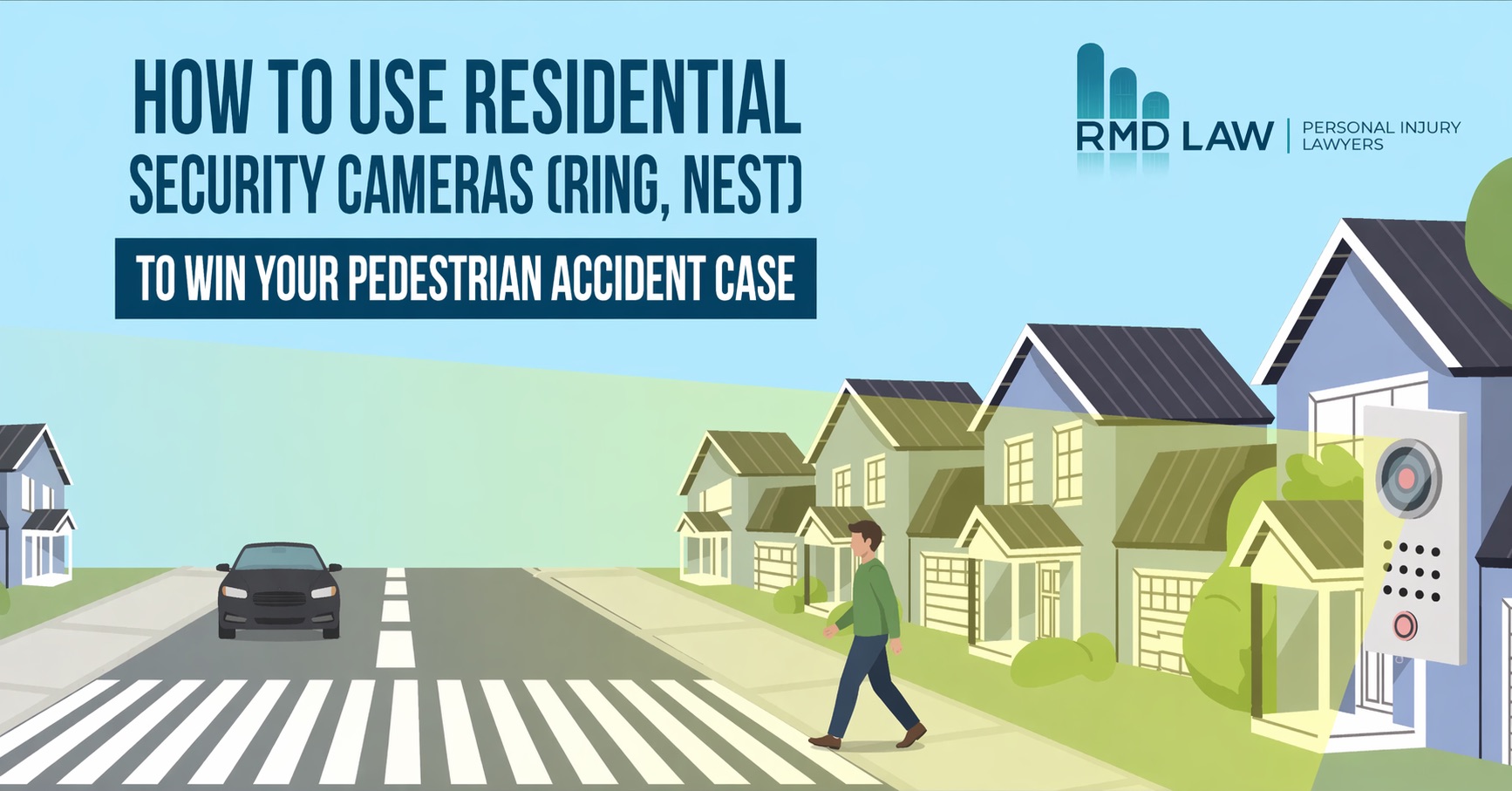
These popular devices provide wide-angle coverage encompassing streets, sidewalks, and driveways. Because they rely heavily on motion sensors, they trigger active recording right as vehicles approach. You might secure a crucial clip showing the precise moments before and after the impact. Some units also record audio. A built-in microphone can catch the harsh screech of braking tires or a driver’s immediate verbal reaction. Keep in mind that the parent company stores these files in the cloud for only a strictly limited time.
Nest Cameras
Google’s hardware operates slightly differently. Depending on the homeowner’s subscription tier, these systems often offer continuous video history rather than isolated motion clips. Finding Nest camera footage gives your case a massive advantage. You have a significantly higher chance of capturing the complete, uninterrupted sequence of events. This continuous feed helps your legal team establish an airtight timeline and prove erratic driver behavior patterns blocks before the actual crash. Like Ring, these files sit on cloud servers programmed with automatic deletion timelines.
Standard Doorbell Cameras
Generic doorbell lenses point directly out toward the street. This specific orientation creates an ideal vantage point for pedestrian crashes. Standard doorbell camera footage perfectly frames your crosswalk use, ambient lighting conditions, and overall visibility to approaching traffic. People frequently overlook these tiny devices. Yet, they remain critical tools in suburban neighborhoods. You can typically access this evidence very quickly if the local property owners agree to cooperate.
7 Critical Steps to Use Residential Security Camera Footage in a California Pedestrian Accident Case
In “he-said-she-said” pedestrian accidents, residential recordings hold the key to proving what really happened. You need to secure and use this evidence properly before the system wipes it clean. Here is how you do exactly that.
1. Know when footage is legal to use
California law allows you to use a neighbor’s video if you obtain it legally. You cannot trespass or coerce someone into handing over their files. Thankfully, courts agree that drivers and pedestrians have zero expectation of privacy on public streets and sidewalks. Any clip you gather must remain authentic, relevant, and completely unaltered. Pay close attention to sound. State law requires two-party consent for audio recordings. This rule sometimes complicates evidence if the camera picked up a private conversation right before the crash.
2. Move fast before the footage is deleted
Cloud storage costs tech companies money. They manage this expense by routinely wiping their servers. Homeowners usually lose older Ring camera footage in just 30 to 60 days. People relying on Nest camera footage might see their systems overwrite data even faster. You must act within hours or days of your accident to prevent permanent data loss.
3. Locate homes with doorbell camera footage
Start your search near the exact point of impact. Stand on the sidewalk and look for lenses mounted near front doors, garage eaves, or porch lights. You want to prioritize exterior cameras facing the street. Focus entirely on angles that directly cover the crosswalks, the surrounding pavement, and the flow of traffic.
4. Canvas the area respectfully
Knock on doors during reasonable daytime hours. Politely explain your situation and ask homeowners for their help. Share the exact date and time they need to check their archives. If nobody answers, leave a brief, polite note with your contact details. Avoid aggressive or intrusive behavior entirely. You rely heavily on their goodwill.
5. Request footage the right way
Keep your request hyper-specific. Give the neighbor a narrow 15-minute window to search. Ask them to email or text you the raw files or a direct download link. Never pressure a reluctant resident to hand over their personal property. If they hesitate, a lawyer can step in and send a formal request later.
6. Preserve the evidence properly
Treat these digital files carefully. Save multiple backup copies on different devices immediately. You must maintain the original file format and all associated metadata. Keep a written record detailing exactly where and how you acquired the clip. Never crop, filter, or alter the video in any capacity. Opposing counsel will use any edit to question the evidence’s validity.
7. Use footage to strengthen your case
A clean video helps prove fault in aggressive disputes. It definitely counters the dreaded “dart-out” claim. You can show the insurance company the driver’s excessive speed, your clear visibility, and their absolute failure to yield. An attorney knows how to secure, authenticate, and present this visual proof to maximize your compensation.
How a Pedestrian Accident Lawyer Can Help Secure and Use Camera Footage
Navigating a personal injury claim while healing from physical trauma overwhelms even the strongest individuals. An experienced attorney takes that burden off your shoulders.
Here is exactly how a legal team leverages digital evidence to win your case:
1. Quickly deploy investigators to canvas neighborhoods
While you recover, our investigators hit the pavement. They thoroughly canvas the surrounding neighborhood to identify specific houses with mounted cameras. Getting professionals on the scene immediately secures the video before automatic deletion cycles erase the truth.
2. Send formal preservation letters to homeowners and companies
Reluctant neighbors occasionally need a firm legal push. A pedestrian accident lawyer can issue formal preservation letters explicitly demanding that they keep the files intact. This crucial action legally prevents a homeowner or a corporation from destroying the digital recordings.
3. Subpoena footage if necessary
Sometimes, property owners flatly refuse to cooperate. If a resident locks down their system, a lawyer does not simply walk away. Attorneys possess the legal authority to subpoena the footage and force compliance through the courts when a specific recording holds the key to your victory.
4. Authenticate and prepare video evidence for court
A raw video clip means nothing if a judge rejects it. Legal teams authenticate the digital files, track the metadata, and establish a rigid chain of custody. A lawyer can organize the evidence properly so it easily clears the strict admissibility hurdles found in California courtrooms.
5. Work with experts to interpret footage (speed, distance, visibility)
Raw pixels rarely reveal the entire scientific reality of a crash. A pedestrian accident attorney in California can collaborate closely with accident reconstruction professionals. These experts analyze frame rates to calculate precise vehicle speeds, exact braking distances, and your ambient visibility at the exact moment of impact.
6. Use video to counter insurance company defenses
Insurance adjusters fight aggressively to minimize payouts. They routinely blame the pedestrian for the collision. The video directly dismantles their fabricated excuses and shuts down their standard defenses entirely.
7. Maximize compensation by clearly establishing liability
A powerful visual record leaves the defense team nowhere to hide. Clearly establishing liability forces the insurance company to take your claim seriously. This irrefutable proof allows your lawyer to aggressively pursue the maximum financial recovery you deserve.
Let the Footage Do the Talking
Disputed pedestrian collisions leave victims feeling entirely helpless. Without hard evidence, a driver’s fabricated story often dictates the police report. A clear recording from a nearby porch completely shifts that dynamic. Residential security clips prove exactly what happened, forcing the insurance company to abandon its excuses and face reality.
However, you face a rapidly ticking clock. Tech companies wipe these crucial files from their cloud servers in a matter of days. A dedicated pedestrian accident lawyer in California knows exactly how to track down, preserve, and leverage this digital proof. The legal team at RMD Law acts immediately to protect your rights and dismantle unfair “dart-out” defenses.
Reach out to RMD Law today for help securing and using critical evidence before it disappears.
FAQs
Video evidence instantly clears up “he-said-she-said” disputes by proving right-of-way, capturing vehicle speed, and destroying “dart-out” defenses. Courts trust objective recordings far more than conflicting witness memories.
Yes. California allows legally obtained residential recordings. Motion-activated Ring camera footage provides critical timestamps and street angles to prove your claim. Remember, you cannot trespass to acquire these digital files.
Storage times vary heavily by subscription. Free accounts might only save motion events for a few hours. Paid plans offer up to 60 days of continuous Nest camera footage. Always request this evidence immediately before servers overwrite it.
Respectfully canvas the neighborhood near the accident scene and ask homeowners to check their systems for the exact crash time. Act fast to secure doorbell camera footage, as cloud platforms routinely delete older files.
You cannot force a homeowner to surrender their digital property. However, a lawyer can step in to issue a formal preservation letter or a legal subpoena to secure the necessary recordings without violating the resident’s rights.
Attorneys rapidly deploy investigators to canvas areas and legally demand evidence to prevent automatic deletion, for help recovering critical files before they disappear, and to properly build your case.

- School Zone Pedestrian Accidents in California: Who’s Liable? - September 17, 2026
- Two Roads, 76 Deaths: New Data On Fresno County’s Most Dangerous Roads - September 15, 2026
- Why Wrong-Way Crashes Are Increasing in Orange County at Night - September 10, 2026