Key Takeaways
Finding the right care immediately after a catastrophic accident dictates your physical and financial recovery, which is why you must know where the Level 1 trauma centers in Southern California are.
- Not all hospitals are equipped for major trauma: While standard ERs stabilize everyday emergencies, Level 1 centers have board-certified trauma surgeons, neurosurgeons, and rapid access to advanced life-saving technology 24/7, such as CT scanners, MRI, and a dedicated blood bank.
- The “Golden Hour” saves lives: Reaching a trauma center within the first 60 minutes of a severe injury reduces the risk of permanent, life-altering complications and significantly improves survival rates through rapid trauma activation protocols.
- Top-tier care is heavily centralized: Southern California relies on elite medical hubs like UCLA, Cedars-Sinai, and UC Irvine for the most complex and life-threatening cases requiring trained specialists and state-of-the-art facilities.
- Specialized medical records strengthen your legal claim: The rigorous documentation of a Level 1 facility provides undeniable evidence of your injury’s severity, helping your California legal team secure maximum compensation, including economic damages, non-economic damages, and future medical costs, for your long-term recovery.
Map of Level 1 Trauma Centers in Southern California
Traumatic injuries—whether caused by serious car accidents, falls, or violent incidents—require immediate and highly specialized medical care. In Southern California, where millions rely on busy highways and dense urban infrastructure, these emergencies are not uncommon.
Many families assume that any emergency room can provide the same level of care. However, not all hospitals are equipped to handle the most critical cases. In reality, hospitals are classified into different trauma levels based on their resources, staffing, and capabilities, including access to specialized equipment like helipads for air ambulance transport and dedicated trauma bays for immediate triage.
A Level 1 trauma center in California can represent the highest degree of care, equipped to treat the most severe and life-threatening injuries, including polytrauma, blunt force trauma, penetrating trauma, spinal cord injury, and burn injury. In regions like Los Angeles, Orange County, and San Diego, knowing where these facilities are can make a life-saving difference, impacting not only survival but also long-term recovery.
Beyond the medical implications, the quality of care and documentation at these facilities can also play a significant role in personal injury claims and wrongful death lawsuits. Families navigating both recovery and legal challenges must understand this distinction when evaluating what their case is worth and how to get medical records for litigation.
This guide explains the difference between standard emergency rooms and Level 1 trauma centers, maps out key facilities across Southern California, and highlights why these institutions matter both medically and legally.
Understanding Trauma Center Levels
Trauma care systems in the United States operate on a tiered hierarchy designed to match a patient’s specific needs with a hospital’s immediate resources. This structured approach ensures that victims of severe accidents receive definitive surgical care within the “Golden Hour”—the critical first sixty minutes.
While every hospital with an emergency room can provide basic life support, only those verified by organizations like the American College of Surgeons (ACS) possess the specialized infrastructure to manage complex, multi-system trauma.
What’s the Difference Between a Standard ER and a Level 1 Trauma Center?
A standard emergency room is designed to stabilize patients and treat a wide range of urgent medical conditions. While ERs play a role in the healthcare system, they may not have the specialized staff or equipment needed for the most severe trauma cases that may require immediate surgical intervention and advanced pain management.
In contrast, trauma centers are designated based on their ability to treat serious injuries. A Level 1 trauma center in Southern California can represent the highest quality of care. These facilities provide:
- 24/7 availability of trauma surgeons and specialists, including neurosurgeons and orthopedic surgeons
- Advanced imaging (such as CT scanners, MRI, and ultrasound), operating rooms, and life-saving technology
- Comprehensive care from initial resuscitation through rehabilitation
- Research programs and training for future trauma specialists
Lower-level trauma centers (Levels 2–4) may still provide important services, but they often lack the full range of specialists or resources available at Level 1 facilities.
Emergency medical services (EMS) personnel are trained to assess injury severity at the scene. In critical cases, they may bypass closer hospitals to transport patients directly to a Level 1 trauma center in California, where advanced care is immediately available.
Mapping Southern California’s Level 1 Trauma Network
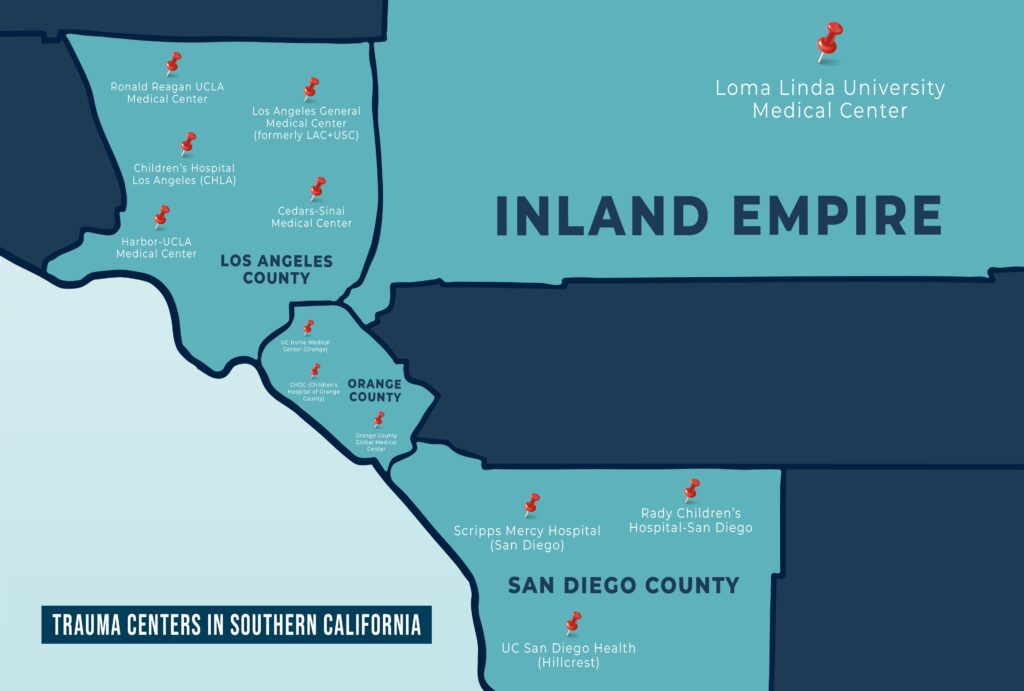
Southern California maintains one of the most sophisticated and highly regulated trauma systems in the nation to serve its massive, mobile population. The following directories highlight the premier institutions equipped to handle the most complex adult and pediatric cases in 2026.
Level 1 Trauma Centers in Los Angeles County, CA
Los Angeles County spans a vast geographic area and relies on five elite Level 1 facilities as anchors of its emergency network.
- Los Angeles General Medical Center (formerly LAC+USC): Located near downtown, this is one of the busiest trauma centers in the country and a primary resource for the region’s most critical cases.
- Ronald Reagan UCLA Medical Center: Serving the westside, the facility is globally recognized for its advanced neurosurgical and multi-organ transplant capabilities.
- Cedars-Sinai Medical Center: A major private-sector leader in trauma care that provides comprehensive services for the central Los Angeles area.
- Harbor-UCLA Medical Center: This facility provides a vital safety net for the South Bay and coastal communities.
- Children’s Hospital Los Angeles (CHLA): As the only freestanding Pediatric Level 1 trauma center in the county, it focuses on the unique physiological needs of injured children.
Level 1 Trauma Centers in Orange County, CA
While Orange County has fewer Level 1 designations than its neighbor to the north, its facilities are highly specialized.
- UC Irvine Medical Center (Orange): The unique regional powerhouse serves as the only facility in the county verified for both Adult Level 1 and Pediatric Level 2 trauma care.
- CHOC (Children’s Hospital of Orange County): Recently verified as a Level 1 Pediatric trauma center, CHOC is the essential destination for pediatric-specific emergency surgery and recovery.
- Orange County Global Medical Center: A critical Adult Level 2 resource that frequently coordinates with Level 1 hubs for the region’s most complex cases.
Level 1 Trauma Centers Near You in San Diego County and the Inland Empire
The southernmost part of CA and the eastern corridors rely on integrated networks that bridge long distances.
- UC San Diego Health (Hillcrest): The region’s first Level 1 center remains a leader in trauma system management and research.
- Scripps Mercy Hospital (San Diego): A high-volume metro facility that provides top-tier adult trauma services for the San Diego basin.
- Rady Children’s Hospital-San Diego: This is the primary Pediatric Level 1 resource for San Diego, Imperial, and southern Riverside counties.
- Loma Linda University Medical Center: Located in the Inland Empire, this facility holds dual Level 1 designations for both adults and children, serving as a critical hub for a massive inland population.
Why Minutes Matter: The Life-Changing Impact of Specialized Trauma Care
When you suffer a major injury, the medical care you receive in the first hour often determines your quality of life for the next several decades. Level 1 trauma centers are specifically designed to maximize this window of opportunity.
- The golden hour principle: The first 60 minutes after a traumatic injury represent a high-stakes period where prompt medical intervention can significantly improve survival rates.
- Immediate stabilization and assessment: Healthcare providers at these centers perform rapid assessments—checking airway, breathing, and circulation—to identify and treat life-threatening issues within minutes of arrival.
- Reduced risk of permanent complications: Access to immediate specialized surgery reduces the likelihood of irreversible damage such as internal bleeding, organ failure, or permanent brain damage.
- Coordinated, multidisciplinary care: You receive integrated treatment from a team that includes trauma surgeons, neurosurgeons, and orthopedic experts working simultaneously rather than waiting for on-call doctors to travel to the hospital.
- Connection to long-term recovery: High-level intervention in the early stages directly affects your future mobility, cognitive function, and independence.
- Financial and logistical relief: Effective early treatment at a designated trauma center can reduce the duration of hospital stays and lower the astronomical costs associated with long-term disability and rehabilitation.
- Legal significance of medical documentation: Because Level 1 centers follow rigorous, standardized reporting protocols, their records provide powerful evidence of injury severity and causation for personal injury claims.
How RMD Law Supports California Trauma Victims
Dealing with the aftermath of a catastrophic accident is an immense burden, but you do not have to carry it alone. While you focus on medical recovery, a legal team ensures that the high-level care you received is accurately reflected in your pursuit of justice.
1. Evaluate accident liability
Our team investigates complex scenarios, such as commercial truck or motorcycle accidents, to identify every responsible party.
2. Preserve crucial evidence
We act quickly to secure photos, witness statements, and surveillance footage before they disappear.
3. Navigate insurance claims
We handle the aggressive tactics of insurance companies that often try to downplay the severity of permanent injuries or future medical needs.
4. Pursue compensation for injuries
Our attorneys calculate the true cost of your recovery, including medical bills, future lost earnings, and emotional distress.
5. Provide guidance on legal deadlines
We make sure that your claim meets California’s strict statutes of limitations, which is typically two years from the date of the injury.
From Risk to Responsibility
Knowing where to go in a medical emergency can make a life-altering difference. Level 1 trauma centers provide the highest quality of care for severe injuries, offering specialized treatment that can improve survival and long-term recovery outcomes.
In Southern California, access to these facilities is important—especially in high-risk areas where serious accidents are more likely. Beyond immediate care, the documentation and treatment received at these institutions can play a key role in protecting a patient’s legal rights.
If you or a loved one has suffered a catastrophic injury and received care at a Level 1 trauma center in Los Angeles, consider speaking with an experienced personal injury lawyer to better understand your options. Contact RMD Law to guide you through the legal process while you focus on recovery.
FAQs
It is the highest ranking that indicates a hospital provides total care for every aspect of an injury. These centers have 24/7 in-house surgeons and lead the state in medical research and education.
There are currently five officially designated Level 1 centers in the county. Four serve adults—Cedars-Sinai, Harbor-UCLA, LA General, and Ronald Reagan UCLA—while Children’s Hospital Los Angeles serves pediatric patients.
The golden hour is the first 60 minutes after an injury, when rapid medical intervention is most effective in preventing death or permanent disability. Reaching a Level 1 center during this window maximizes your chances of a successful recovery.
Yes, the detailed trauma flow sheets and specialist reports from these centers are essential for proving the severity of catastrophic injuries. They help establish the need for long-term compensation, such as Life Care Plans.

- Traumatic Brain Injury Long-Term Effects and How to Secure Your Settlement - October 20, 2026
- 2026 Updates to California E-Bike and Motorized Scooter Sidewalk Laws - October 15, 2026
- Map of Level 1 Trauma Centers in Northern California: Where to Go When Seconds Count - October 13, 2026