
Key Takeaways
Lane splitting and lane filtering are both illegal in Texas
- Texas Transportation Code §545.060, as amended by HB 4122 in 2023, bars motorcyclists from operating between lanes of traffic moving in the same direction, regardless of how fast or slow that traffic is moving.
Lane splitting and lane filtering are not the same maneuver
- Splitting happens between lanes of moving traffic. Filtering happens between vehicles that are stopped or barely moving, mostly at a red light. Texas treats both the same way under one statute.
Tickets run $175 to $300, but the bigger cost shows up later
- Riders cited for splitting or filtering face a moving violation, points on their record, insurance hikes, and a fault problem if a crash follows.
HB 2957 tried to legalize limited lane filtering in 2025 and died in committee
- The 89th Legislature let the bill expire without a floor vote on June 2, 2025. No path to legalization is active right now.
A few states allow what Texas does not
- California, Utah, Arizona, Montana, Colorado, and Minnesota all permit some form of splitting or filtering. Since Texas does not, crossing into Texas on a road trip means the rule changes at the border.
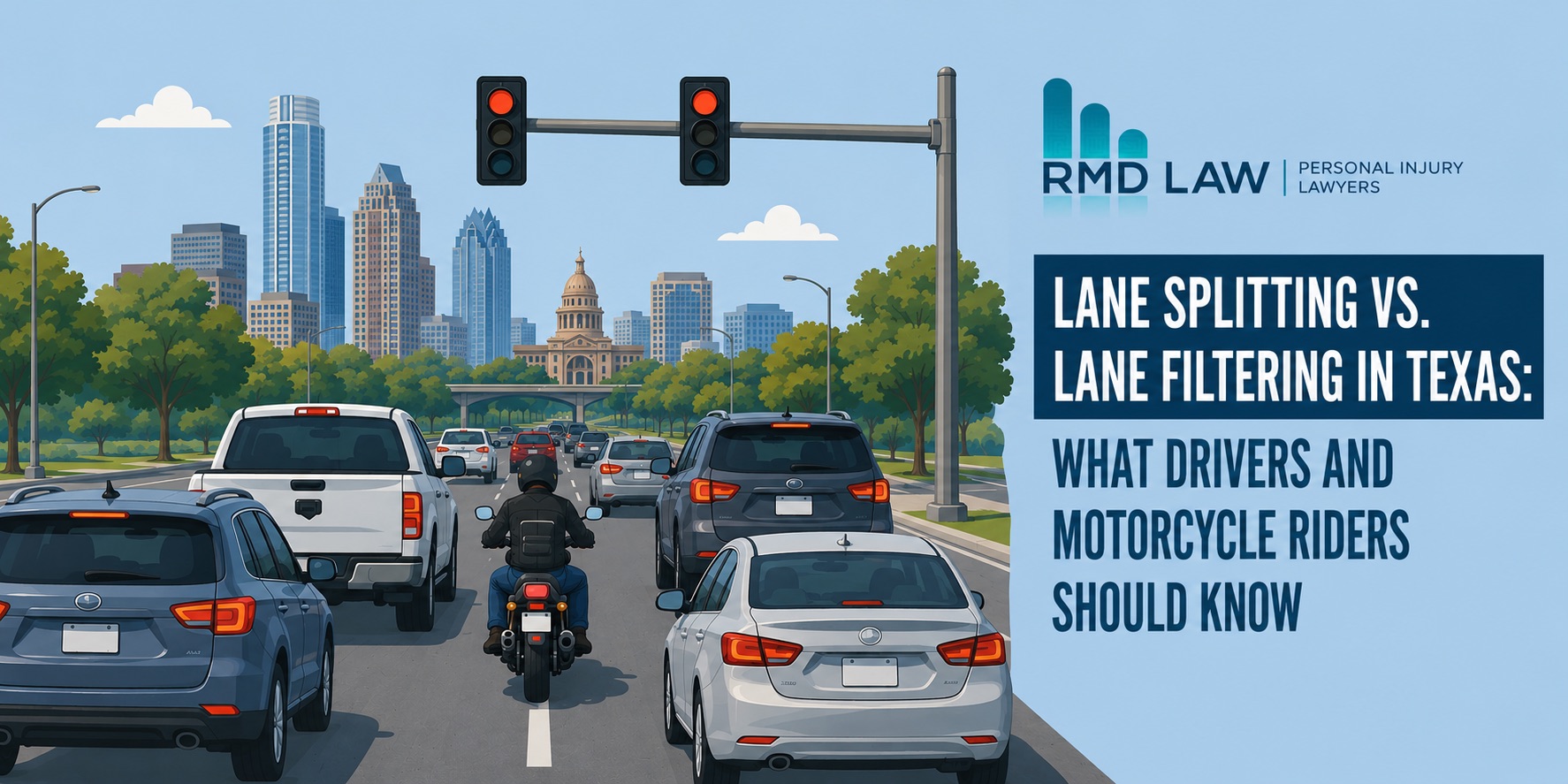
A motorcyclist sits in stopped traffic on I-35. The rider sees a gap, eases between two cars, and rolls up to the front of the light. What is routine in some states could result in a ticket in Texas.
Most riders use the terms lane splitting and lane filtering as if they mean the same thing because Texas state law treats both the same. However they do not, and the difference carries legal weight in every state that addresses this topic.
Here’s what riders need to know about the law, penalties, and how these maneuvers can affect a motorcycle accident claim.
Lane Splitting vs. Lane Filtering: The Definitions
The two maneuvers share a basic idea: a motorcycle passes between rows of cars by using space inside a lane instead of changing lanes the way a car would. The speed and the traffic conditions make the difference.
What is lane splitting?
Lane splitting is riding between two lanes of traffic that are both moving in the same direction at speed. The rider threads the white line during heavy congestion or stop-and-go highway driving, and overtakes cars without changing lanes. California is the only state in the country that allows it without restrictions.
What is lane filtering?
Lane filtering is the slower cousin. The rider moves through a gap between cars that are stopped or barely creeping, at red lights or in intersection backups. The rider advances to the front of the line, then takes off when the light turns green. Utah, Arizona, Montana, Colorado, and Minnesota all permit some version of filtering under tight conditions.
Why the distinction has weight in most states
Filtering is considered the safer of the two maneuvers because the surrounding cars are stationary. Rear-end collisions often kill motorcyclists at intersections, and filtering removes riders out of this high-risk area. That safety argument is why most legalization efforts target filtering, and exclude splitting.
How Does Texas treat lane splitting and lane filtering?
Texas does not draw the line between splitting and filtering. The statute treats any movement between lanes of same-direction traffic as a violation. Stopped traffic, slow traffic, fast traffic, none of it changes the analysis.
What Texas Transportation Code §545.060 Says
Section 545.060 of the Texas Transportation Code is the lane-use statute that applies to every vehicle on a roadway, including motorcycles. It requires a driver on a roadway divided into two or more clearly marked lanes to drive “as nearly as practical entirely within a single lane” and prohibits movement from the lane unless that movement can be made safely.
Before 2023, that language was the basis for ticketing riders who split lanes, since splitting by definition puts the bike outside a single lane. The argument worked, but it was inferred, not stated.
The legislature introduced in 2023 ended any push back from riders, defense lawyers, and judges.
HB 4122 closed the loophole
House Bill 4122, signed by Governor Greg Abbott and effective September 1, 2023, amended §545.060 to specifically address motorcycles. The new language states that the operator of a motorcycle may not operate the motorcycle between lanes of traffic moving in the same direction, and may not pass a motor vehicle while in the same lane as the vehicle being passed.
The amendment removed every gray area. Lane splitting is illegal. Lane filtering is illegal. Two motorcycles sharing one lane to ride together remains permitted, but only when neither is passing the other inside the lane.
What this looks like on the road
A rider stuck behind a car at a red light cannot move around it inside the lane. Riders on a congested stretch of US-290 in Houston cannot use the dotted line as a passing zone. A rider in heavy MoPac traffic in Austin cannot filter to the front of an exit ramp. All of these moves now have a statute attached.
How Much Does a Lane Splitting Ticket Cost in Texas?
Most lane splitting and lane filtering tickets in Texas run between $175 and $300 in fines. Court costs add another $50 to $150 depending on the jurisdiction. The fine itself is the smallest part of the price tag.
The downstream costs hit harder.
A moving violation on a motorcycle in Texas adds points to the driver’s record. Insurance carriers raise premiums on riders who pick up traffic citations, sometimes by 30% or more at renewal. And the ticket itself becomes evidence if a crash happens at the same time as the maneuver.
The crash multiplier
This is where lane splitting and lane filtering get expensive. Texas follows a modified comparative negligence rule. If a jury finds the injured party 51% or more at fault, recovery drops to zero. If the jury finds the injured party less than 51% at fault, the recovery is reduced by the percentage assigned.
A rider hit by a car while splitting lanes has a serious comparative fault problem. Insurance adjusters and defense lawyers know that the maneuver itself is illegal under §545.060. The opening argument writes itself: the rider was breaking the law at the moment of impact.
That does not always lose the case. The driver who turned across a motorcycle or merged without checking the blind spot still bears responsibility for the actions that caused the collision. But the rider’s fault number goes up, and the settlement value goes down,by a lot.
How Texas Compares to States that Allow the Maneuver
Six states permit some form of splitting or filtering. The conditions vary, and none of them match Texas.
| State | What’s allowed | Speed limit for the bike | Traffic condition |
|---|---|---|---|
| California | Full lane splitting | No statutory cap; California Highway Patrol guidance suggests ≤10 mph over traffic | Any speed, any time |
| Utah | Lane filtering only | ≤15 mph | Roads ≤45 mph, traffic stopped |
| Arizona | Lane filtering only | ≤15 mph | Roads ≤45 mph, traffic stopped |
| Montana | Lane filtering only | ≤20 mph | Within 10 mph of traffic, stopped or slow |
| Colorado | Lane filtering only | ≤15 mph | Traffic in adjacent lanes fully stopped |
| Minnesota | Lane filtering only | ≤25 mph | Traffic at 25 mph or less |
| Texas | Neither | Not applicable | Both maneuvers prohibited under §545.060 |
A rider crossing from New Mexico, Oklahoma, Louisiana, or Arkansas into Texas inherits Texas law the moment the tires cross the state line. Out-of-state plates do not change the analysis.
HB 2957 and the 2025 Legalization Push that Failed
Representative Ron Reynolds filed House Bill 2957 in the 89th Legislature in February 2025. The bill would have legalized a narrow form of lane filtering on divided highways with at least two lanes in each direction, only when the vehicle being passed was stopped or moving at 10 mph or less, and only at a maximum motorcycle speed of 20 mph.
The bill also addressed two-up lane sharing for motorcycles riding together, and added explicit language preventing other drivers from crowding motorcycles out of a lane.
It went to the Transportation Committee on March 20, 2025 but never received a floor vote. The bill died on June 2, 2025 when the session ended.
Support from the American Motorcyclist Association and Texas-based rider groups was not enough to overcome opposition from law enforcement and several insurance industry voices. No similar legislation has been refiled.
For now, Texas remains a no-splitting, no-filtering state. The next chance for a change is the 90th Legislature in 2027.
What if You Were Hurt While Lane Splitting or Filtering in Texas?
Riders get hurt in these situations more than the public realizes: a driver opens a door, a car drifts inside its lane and clips the bike, a vehicle changes lanes without seeing the motorcycle in the gap. The rider goes down, the driver claims they never saw the bike, and the police report mentions the maneuver.
The case is not unwinnable, but it is harder, and requires faster work.
Comparative fault becomes the battleground
Defense lawyers will frame the entire incident around the rider’s choice to split or filter. The argument is straightforward: a legal motorcyclist would have been safely inside a lane, so the crash would not have happened. That argument loses some of its weight when the other driver did something independently negligent, like running a red light, texting, or making an unsafe lane change.
The fault analysis is rarely all-or-nothing. A skilled motorcycle accident attorney can keep the rider’s share below the 51% bar, maintaining the ability to recover damages, especially when the other driver’s conduct is documented.
Evidence disappears fast
Surveillance camera footage from nearby businesses gets overwritten in days. Dashcam files get deleted. Witnesses lose phone numbers and forget details. The investigation needs to start immediately, not weeks later when the insurance company starts pushing back.
Insurance carriers know the statute
The other driver’s insurer will know about §545.060 within hours of receiving the claim. The adjuster will lead with comparative fault and try to settle low or deny the claim outright. Riders who handle these cases alone end up accepting offers that fail to cover most of the medical bills and lost wages.
What this Means for Texas Riders in Austin, Houston, and Dallas
Austin congestion on Mopac, I-35, and 183 makes filtering tempting, especially during stop-and-go afternoon traffic. The statute applies. Texas DPS troopers, Austin PD motors, and Travis County constables all write the citation.
Houston riders on I-10, US-59, and the 610 Loop face the same legal exposure. Harris County led Texas in motorcycle crashes in 2025, with roughly 1,300 motorcycle crashes and 68 fatalities according to preliminary state data. Riders who split or filter in that environment carry both the legal heightened crash risk.
Dallas-Fort Worth riders working through traffic on I-635, the Dallas North Tollway, or I-30 face the same exposure. DPD’s motor unit and Tarrant County deputies enforce the statute consistently.
The maneuver is illegal everywhere in Texas. The enforcement intensity varies by department, but the citation is the same.
FAQs
No. Texas Transportation Code §545.060, as amended by HB 4122 in 2023, prohibits motorcyclists from operating between lanes of traffic moving in the same direction. The prohibition took effect September 1, 2023, and remains in force statewide.
No. The same statute that bans lane splitting also bans lane filtering. Texas does not draw a legal distinction between splitting moving traffic and filtering between stopped cars at a light. Both are violations of §545.060.
Fines run $175 to $300, plus court costs. The citation is a moving violation, which adds points to the driver record and can raise insurance premiums at renewal.
Lane splitting is passing between lanes of moving traffic, up to highway speeds. Lane filtering is moving between cars that are stopped or crawling, mostly at red lights. Most states that permit lane filtering still prohibit lane splitting.Texas prohibits both.
No. House Bill 2957, which would have legalized a narrow form of lane filtering, died in committee on June 2, 2025. The bill never received a floor vote, and no replacement legislation is currently active.
You can, but the case is harder. Texas uses a modified comparative fault rule, and the illegal maneuver gives the other driver’s insurer an argument to push blame onto the rider. If your fault share lands at 51% or higher, you recover nothing. Below 51%, your recovery is reduced by your fault percentage. An experienced motorcycle accident lawyer can fight to keep that number down by focusing on what the other driver did wrong.
No. Two motorcycles riding side-by-side in the same lane is legal in Texas under §545.060(d). What is prohibited is passing another vehicle inside the same lane, or riding between lanes of traffic. Sharing a single lane with another rider, without passing in that lane, is allowed.
Hurt in a Texas motorcycle crash? Talk to a lawyer who knows the statute
Lane splitting and lane filtering cases turn on details the average insurance adjuster will not surface: the angle of impact, the driver’s distraction, the condition of the road, the exact statutory language, whether the rider was between lanes or simply close to the line.
RMD Law represents injured motorcyclists across Texas, with offices in Austin and also serving Houston, Dallas, Fort Worth, and San Antonio. Free consultations, 24/7. No fee unless we win your case.
Call (512) 580-7070 or contact us online for a free case review.

- How to Calculate Your Own Out-of-Pocket Medical Costs Before Calling a Lawyer - October 1, 2026
- Orange County Community Events This Fall: Smart Travel and Traffic Safety Tips - September 29, 2026
- Why Wrong-Way Crashes Are Increasing in Orange County at Night - September 24, 2026


