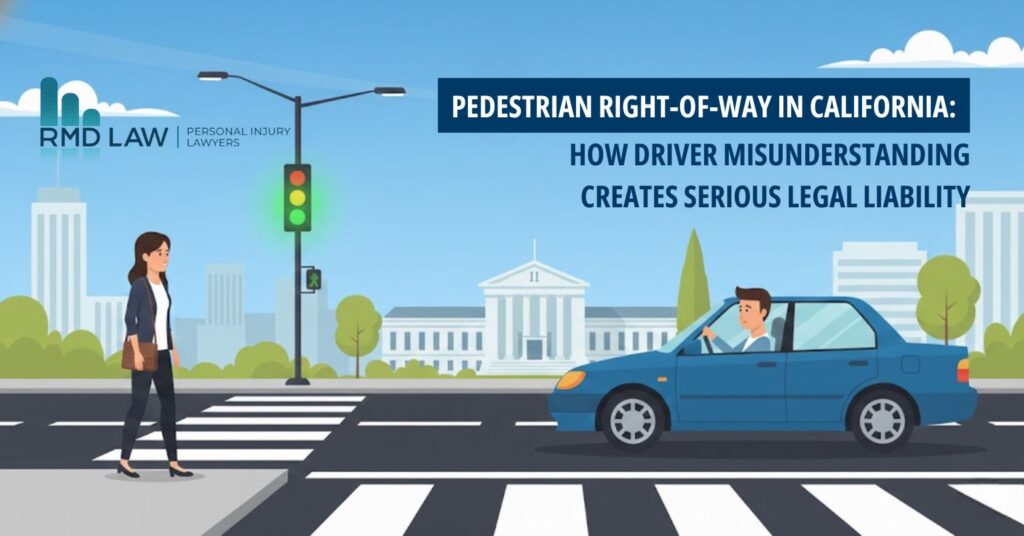
California’s streets are increasingly dangerous for pedestrians, and the consequences are often catastrophic. In 2023 alone, more than 1,100 pedestrians were killed on California roadways, with thousands more suffering serious and permanent injuries. From a personal injury perspective, these numbers are not abstract statistics. They represent real people facing life-altering trauma, mounting medical bills, lost income, and long-term disability.
In a state where walking is a daily necessity in dense urban areas from Los Angeles to the Bay Area, misunderstanding pedestrian right-of-way laws is one of the most common factors we see in serious injury claims. Many of these collisions are not unavoidable accidents. They are the predictable result of drivers failing to understand or comply with their legal duties.
Below are the most common misconceptions drivers have about pedestrian right-of-way in California, and how those misunderstandings translate directly into legal liability and civil exposure after a serious injury or fatality.
Key Takeaways
- Pedestrian rights extend to unmarked crosswalks.
Drivers must yield to pedestrians at both marked and unmarked intersections. The absence of painted lines does not eliminate a pedestrian’s legal right-of-way under California Vehicle Code § 21950. - Drivers still owe a duty of care outside crosswalks.
Even when a pedestrian crosses mid-block or makes a mistake, drivers must exercise reasonable care to avoid collisions. Liability is often evaluated through comparative fault, not absolutes. - Jaywalking does not automatically protect drivers.
Under AB 2147 and updated CVC §§ 21950-21955, pedestrian violations are no longer a blanket defense. The focus is on whether the driver acted with reasonable care to prevent harm. - Turning and crosswalk obstructions create high-risk situations.
Right turns on red or creeping into a crosswalk are frequent causes of serious injuries. Drivers are legally responsible for ensuring the crosswalk is fully clear before proceeding. - Vulnerable pedestrians require heightened attention.
Special care is required in school zones, near crossing guards, and around children, seniors, or blind pedestrians. Failing to yield or exercise caution in these situations can lead to civil liability, fines, and even criminal penalties.
Pedestrian Right-of-Way Is Not Limited to Painted Crosswalks
California law recognizes both marked and unmarked crosswalks, and drivers are required to yield to pedestrians in either one. The absence of painted lines does not mean a crosswalk does not exist.
A crosswalk legally includes the area where the sidewalk boundary lines extend across an intersection, even if there are no painted markings on the roadway. It also includes any portion of the road clearly designated for pedestrian crossing by paint, signage, or other markings. Lateral lines connecting the sidewalks or roadway edges define the boundaries of the crosswalk, and the area between opposite sides of the street at an intersection is determined by these lines. At intersections, including signalized intersections, pedestrians should use designated crosswalks and follow traffic signals to ensure safety and compliance.
This is a major source of driver error. Many motorists assume pedestrians only have rights in visibly marked crosswalks. In reality, most intersections in cities like Los Angeles, Santa Ana, San Diego, Riverside, and San Jose contain unmarked crosswalks by default.
Under California Vehicle Code § 21950, when a pedestrian is crossing within any marked crosswalk or any unmarked crosswalk at an intersection, drivers must yield the right-of-way and must reduce speed or take other action as necessary to safeguard the pedestrian.
In pedestrian injury cases, drivers frequently argue that they did not realize a crosswalk existed. That argument carries little legal weight. The duty to yield applies regardless of paint, signage, or a driver’s personal assumptions, and violations of CVC § 21950 are routinely used to establish fault and civil liability in serious pedestrian accident claims.
Drivers Still Owe a Duty of Care Even Outside Crosswalks
Pedestrians crossing outside a marked or unmarked crosswalk are generally required to yield to vehicles that are close enough to pose an immediate hazard. That does not mean drivers are free to ignore pedestrians or continue driving without regard for safety.
Under California Vehicle Code § 21954, pedestrians outside crosswalks must yield the right-of-way, but the statute expressly states that drivers are still required to exercise due care and take reasonable steps to avoid a collision.
This is a critical legal distinction. Drivers often assume that if a pedestrian is not in a crosswalk, the responsibility disappears. It does not. Due care still applies, even when a pedestrian makes a poor or unsafe decision.
In real injury cases, this situation is rarely a simple yes or no question of fault. It typically becomes a comparative fault analysis, where the conduct of both parties is evaluated. A pedestrian may share some responsibility, but a driver who fails to slow down, react, or avoid a visible person can still be held legally liable for serious injuries.
“Jaywalking” Does Not Automatically Eliminate Driver Liability
California’s pedestrian enforcement laws changed in 2023, and jaywalking is no longer the automatic defense drivers assume it to be.
Under AB 2147, reflected in amendments to California Vehicle Code §§ 21950, 21954, and 21955, law enforcement generally cannot stop or cite a pedestrian for crossing outside a crosswalk unless a reasonably careful person would recognize an immediate danger of collision.
Traditionally, “jaywalking” refers to crossing mid-block between adjacent signalized intersections, as addressed under California Vehicle Code § 21955. The restrictions stated in the law specifically regulate when such crossing movements are permitted or prohibited. Pedestrians must follow traffic signals and only cross at designated areas. Crossing outside these areas may be subject to enforcement if it creates a safety hazard. The law now emphasizes actual safety risks rather than technical violations.
From a liability standpoint, the real issues after a crash are rarely whether a pedestrian crossed mid-block. The legal analysis typically turns on whether the driver was paying attention, traveling at a safe speed, had sufficient time to perceive the pedestrian, and could have avoided the collision through reasonable care. In many cases, a driver’s inattention or failure to react properly remains the primary cause of serious injury, regardless of where the pedestrian was crossing.
Right Turns on Red Still Require Full Pedestrian Clearance
Turning right on red does not give a driver permission to occupy the crosswalk.
California law prohibits stopping a vehicle in a manner that unnecessarily blocks a marked or unmarked crosswalk or sidewalk under CVC § 21970. Even momentary “creeping” into the crosswalk to gain visibility can place pedestrians in danger and create immediate liability exposure.
This is one of the most common pedestrian hazards in dense urban areas. Drivers roll forward to check traffic, their front end blocks the crosswalk, and pedestrians are forced to step into live traffic to pass. When a collision occurs in this scenario, the turning driver is frequently found at fault because the obstruction itself created the dangerous condition. Blocking a crosswalk is not just a technical violation. It is a recurring cause of preventable pedestrian injuries.
Late Entry by a Pedestrian Does Not Eliminate Driver Responsibility
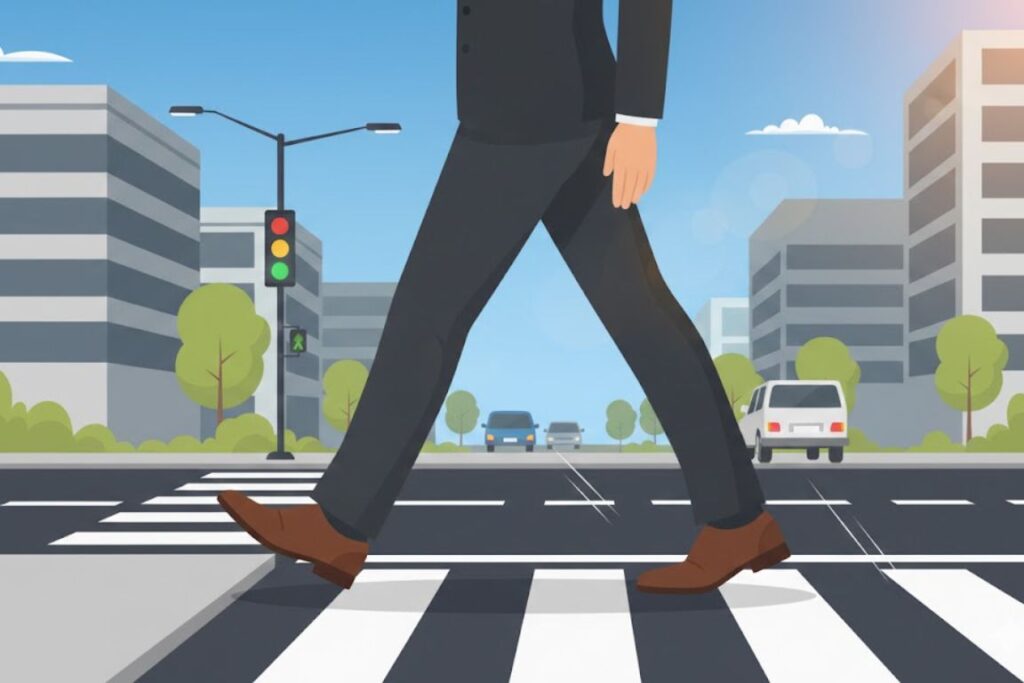
Pedestrians are not permitted to suddenly leave a curb or place themselves in the path of a vehicle that is so close as to constitute an immediate hazard, nor may they unnecessarily stop or delay traffic while within a crosswalk under CVC § 21950. That duty exists and it matters.
The same statute places a continuous and independent duty on drivers. Motorists approaching a crosswalk must exercise all due care and take any reasonably necessary safety measures to avoid a collision. Drivers must ensure that pedestrians can pass safely and remain prepared for a pedestrian walking who may start crossing when permitted by traffic signals.
In real injury cases, the analysis does not stop with whether the pedestrian misjudged timing. The central question almost always becomes what the driver did with the opportunity to perceive, react, slow, or avoid impact. Even when a pedestrian acts carelessly, drivers are still expected to remain alert, adjust speed, and respond appropriately to foreseeable risks. Late entry is not a legal shield against liability.
Where Drivers Most Often Create Serious Risk
These are the recurring fact patterns we see in pedestrian injury litigation. They account for a large percentage of preventable and high liability collisions:
- Failing to yield while turning. This includes left turns on green, right turns on red, and so-called “free” right turns where the driver treats the crosswalk as optional.
- Distracted driving. Most commonly involving phone use, navigation input, or in car distractions that delay perception and reaction time.
- Misjudging pedestrian speed and vulnerability. Especially with children, seniors, and individuals with mobility limitations who cannot accelerate or evade quickly.
- The “multiple threat” crash. One vehicle lawfully stops for a pedestrian, while a second vehicle illegally passes and strikes the pedestrian. This is precisely the danger addressed by CVC § 21951, which prohibits overtaking a vehicle stopped for a pedestrian at a crosswalk.
- Ignoring pedestrian control signals. Pedestrians must follow WALK and DON’T WALK indications under CVC § 21456, and drivers are expected to anticipate lawful crossings at signalized intersections and adjust accordingly.
In practice, these incidents are often preventable and commonly stem from inattention, impatience, or incorrect assumptions by drivers who do not fully recognize the legal protections afforded to pedestrians at crosswalks and intersections.
School Zones, Crossing Guards, and Vulnerable Pedestrians
School zones demand a higher level of caution because the risk factors are fundamentally different from ordinary traffic conditions. Children are smaller, harder to see, and far more unpredictable in their movement. They frequently change direction without warning and are often partially obscured by parked cars, buses, or traffic congestion. From a liability standpoint, these are exactly the conditions where drivers are expected to slow down, heighten their attention, and anticipate pedestrian presence.
California law imposes specific duties in these settings. Drivers are legally required to obey the signals and directions of nonstudent school crossing guards under California Vehicle Code § 2815. A crossing guard has the same authority to control traffic as a traffic signal, and ignoring that direction can result in a citation even if the driver believes the road appears clear.
Drivers also have a heightened duty toward blind pedestrians using a white cane or guide dog. Under California Vehicle Code § 21963, failing to yield in these circumstances can be charged as a misdemeanor and may carry statutory penalties that include fines and potential jail exposure. These cases are treated more seriously because the vulnerability of the pedestrian is obvious and legally recognized.
Legal Consequences: Tickets, DMV Points, and Civil Liability
When a driver violates pedestrian right-of-way laws, the legal consequences rarely stop with a traffic ticket. Most right-of-way violations carry financial penalties that quickly escalate once mandatory assessments and surcharges are added. What begins as a basic citation can easily result in several hundred dollars in total fines.
Beyond fines, many pedestrian-related violations are point-count offenses under California’s negligent operator system, including sections such as CVC §§ 21950, 21951, and 21952. Points increase insurance premiums and, if they accumulate, can place a driver at risk of license suspension. From an insurance standpoint, these violations are often treated as indicators of high-risk driving behavior.
The most serious exposure, however, is civil liability. If a driver’s conduct causes injury, the driver may face a personal injury claim seeking compensation for medical treatment, lost income, pain and suffering, and long-term or permanent impairment. These claims are evaluated under California’s comparative fault system, meaning a pedestrian’s conduct may be considered, but it does not automatically eliminate the driver’s responsibility. In many cases, both parties share some degree of fault, and damages are apportioned accordingly.
Protecting Your Health and Legal Rights After a Pedestrian Accident
Pedestrian accidents can have life-changing consequences. Beyond the initial collision, victims often face medical bills, lost income, physical pain, and emotional distress. Taking early and informed action is critical to protecting both your health and your legal rights.
In many pedestrian accidents, drivers fail to exercise reasonable care, particularly when turning at intersections or approaching crosswalks. Collisions can also occur in other areas accessible to pedestrians, such as traversable roadway sections, safety islands, or pedestrian tunnels, so drivers must remain vigilant in these locations as well. Common causes of these accidents include distraction, impatience, or focusing on other traffic instead of pedestrian safety. California law places a strong duty on drivers to remain alert and yield whenever pedestrians are present. While pedestrians are expected to act responsibly, drivers bear the primary responsibility to prevent collisions.
Safety Guidance for Drivers and Pedestrians
For Drivers
- Treat every intersection as a potential crosswalk, even if none is painted.
- Scan the crosswalk and surrounding traffic before turning.
- Never pass a stopped vehicle at a crosswalk.
- Avoid blocking crosswalks while waiting to turn.
- Exercise extra caution at night. Pedestrian fatalities are disproportionately higher in darkness.
For Pedestrians
- Use crosswalks whenever available and obey WALK and DON’T WALK signals.
- When sidewalks are not available, walk on the left side of the road facing the opposite direction of traffic for maximum safety.
- When crossing, use the right half of the crosswalk and cross in the same direction as the walk signal.
- Stay visible and alert, particularly at night or near turning vehicles, even if you have the right-of-way.
If You Are Hit by a Vehicle
- Call 911 and seek immediate medical attention.
- Document the scene with photos or video, gather witness information, and preserve clothing or shoes involved in the accident.
- Request the traffic collision report from local authorities or CHP. These reports are recorded in statewide systems like SWITRS and TIMS.
- Do not provide a recorded statement to the driver’s insurer until you understand your rights.

Injured as a Pedestrian in California? Know Your Legal Rights
If you were injured as a pedestrian in California, the consequences can extend far beyond the initial collision. Medical expenses, lost income, physical pain, emotional distress, and long-term uncertainty often follow. Taking prompt and informed action is essential to protecting both your health and your legal rights.
RMD Law’s experienced pedestrian accident attorneys in California represent individuals injured by drivers who fail to yield or exercise reasonable care. From the earliest stages of the claims process, our firm helps clients ensure injuries are thoroughly documented, medical treatment is coordinated, and critical evidence is preserved. This includes accident reports, medical records, witness statements, and vehicle damage documentation needed to establish liability and damages. Proper documentation of official traffic control devices, including traffic control signals, pedestrian signals, and any other traffic control device present at the scene, is essential in demonstrating driver responsibility in pedestrian accident claims.
We handle all communications with insurance companies to protect our clients from tactics that downplay injuries or shift blame. Our attorneys work to present a clear case that reflects the full physical, emotional, and financial impact of a pedestrian accident. This includes pursuing compensation for medical costs, future treatment, lost wages, reduced earning capacity, and pain and suffering.
Timely legal guidance is especially important in California, where liability can be contested and evidence can disappear quickly. Acting early allows injured individuals to protect their rights and focus on recovery while their legal team manages the claims process.
If you or a loved one has been injured as a pedestrian, RMD Law is committed to helping you secure the full compensation you deserve. Contact us today at (949) 828-0015 for a free consultation.
FAQs
No. In California, pedestrians have the right-of-way in both marked and unmarked crosswalks at intersections. Drivers must yield under California Vehicle Code § 21950, regardless of whether lines or signage are present.
Not automatically. Under recent law updates (AB 2147 and CVC §§ 21950-21955), jaywalking is only relevant if a reasonably careful person would have seen an immediate danger. Drivers still have a duty to exercise reasonable care and can be held liable for injuries.
Yes. Even outside crosswalks, drivers must exercise due care to prevent collisions under CVC § 21954. Pedestrian mistakes do not remove the driver’s legal duty to slow down, react, and avoid harm.
High-risk scenarios include turning at intersections, rolling into crosswalks on right turns, distracted driving, misjudging pedestrian speed, and multiple-threat situations where one vehicle stops but another illegally passes. These are frequent causes of serious injuries.
Yes. Drivers must exercise heightened caution in school zones, obey crossing guards, and yield to blind pedestrians using a cane or guide dog. Failing to do so can result in civil liability, fines, and even criminal charges under CVC §§ 2815 and 21963.

- 2026 Updates to California E-Bike and Motorized Scooter Sidewalk Laws - October 15, 2026
- Map of Level 1 Trauma Centers in Northern California: Where to Go When Seconds Count - October 13, 2026
- Is Driving Slower More Dangerous than Speeding? - October 12, 2026