Key Takeaways
An Orange County bikeways map helps riders navigate strict local trail rules, but corporate insurers will still exploit jurisdictional confusion to deny valid crash claims.
- Class 3 e-bikes face strict 16+ age limits and sidewalk bans.
- Parents face financial exposure when minors cause crashes.
- Photograph motor badges, light setups, and trail signs.
- RMD Law enforces a strict no-recovery, no-fee guarantee.
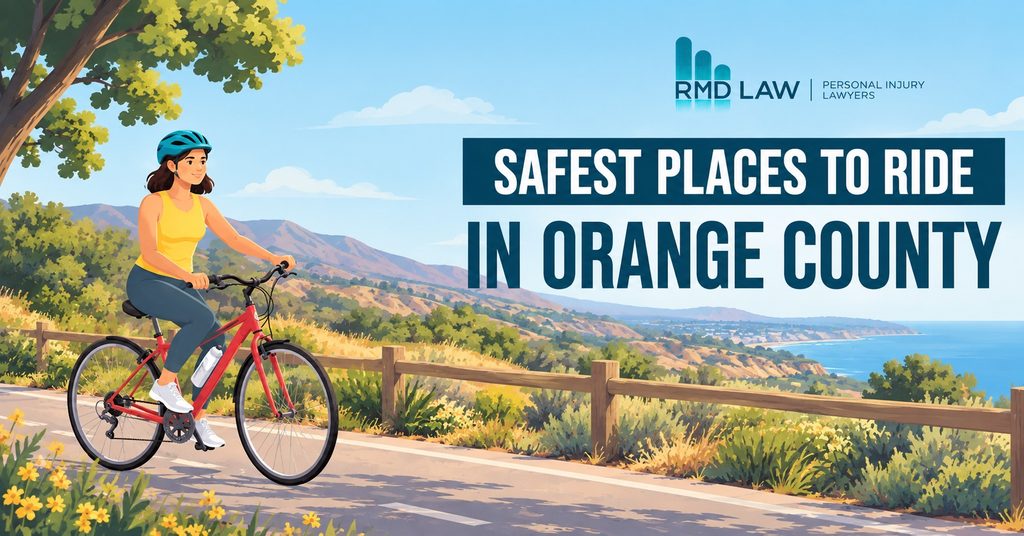
Safest Places to Ride in Orange County
E-bikes are now common on local streets, but rules vary sharply between cities. You can check an Orange County bikeways map to plan a legal route, but a ride permitted on a wide path in Irvine could still draw heavy fines just miles away in Newport Beach. Speed limits, sidewalk restrictions, and helmet rules shift at every municipal border.
These bikes can weigh up to 80 lbs. and reach 28 mph, so a collision with one can still cause severe injuries or disability and costly medical treatment. Insurance companies may use the alleged rule violations to challenge injury claims, such as missing equipment or prohibited sidewalk riding. Homeowners’, renters’, or auto insurance may not cover e-bike accidents.
This guide explains California’s e-bike classifications and Orange County’s local riding rules so you can ride safely and protect your legal rights.

Decoding California E-Bike Classifications Under State Law
Know your electric bike’s legal tier, as it’s your first line of defense against injuries, police citations, and insurance denials. California law divides e-bikes into three legal classes based on motor engagement, throttle capabilities, and top assisted speeds.
Class 1 and Class 2 E-Bikes: Low-Speed Rules and Path Access
Class 1 e-bikes rely on pedal-assist motors that stop providing power once you hit 20 mph. Meanwhile, Class 2 e-bikes feature throttle-driven motors that propel the frame up to 20 mph without pedaling. Both classes must cap their continuous motor output at 750 watts.
You can operate Class 1 and Class 2 e-bikes on most paved multi-use paths across Southern California without age restrictions. But check an official electric bike map before riding, because local park authorities reserve the right to post lower speed caps or restrict throttle usage on crowded pedestrian bridges.
Class 3 E-Bikes: Speed Limits, Age Restrictions, and Sidewalk Bans
Class 3 speed pedal-assist e-bikes operate under tougher state restrictions. These machines assist your pedaling up to 28 mph and must feature a functional speedometer built into the handlebars.
State law mandates that Class 3 riders be at least 16 years old and wear a certified bicycle helmet. California Vehicle Code § 21207.5 bans Class 3 e-bikes from narrow multi-use recreational paths, equestrian trails, and city sidewalks.
Updated California statutes: Equipment mandates and speed modifications
Updated California statutes introduced strict equipment and safety standards. Assembly Bill 544 requires every active e-bike to display a continuous rear red reflector or solid or flashing red light at all times, including direct sunlight. Missing a rear light during a daytime crash gives defense adjusters leverage to claim you contributed to your injuries.
AB 1774 also bans aftermarket speed-tuning chips and modification devices. It will reclassify the cycle as an unregistered motor vehicle under state law. Insurance adjusters comb through crash-scene photographs for missing reflectors or illegal speed hacks. They use technical equipment violations to deny claims.
The legal team at RMD Law knows how to shut down these bad-faith corporate tactics and hold insurers accountable before they lowball an injured family.
Exploring OC’s Premier Trails: Posted Speed Limits and Local Rules
Choosing designated, off-street paved bikeways lowers your risk of a catastrophic motor vehicle impact. Even on protected recreational paths, cyclists still follow city or municipal speed limits and pedestrian right-of-way mandates. Crossing an invisible city border in Orange County can change where you can legally ride.
Back Bay Loop Trail (Newport Beach): Coastal caps and ranger patrols
The Back Bay Loop Trail in Newport Beach is a scenic 10.5-mile paved loop surrounding Upper Newport Bay. You can ride Class 1 and Class 2 e-bikes along the main paved paths, but local park rangers enforce a strict 10 mph speed cap. Class 3 e-bikes face heavy restrictions along narrow unpaved cutouts and wilderness paths.
Newport Beach police actively enforce pedestrian right-of-way rules around Upper Newport Bay, so riders must give audible warnings using a bell or voice before passing on blind curves. Check a current Orange County bikeways map to make sure that you stay on designated paved bikeways rather than protected nature trails.
Jeffrey Open Space Trail (Irvine): Master-planned multi-use safety
Irvine’s master-planned Jeffrey Open Space Trail has a dedicated multi-use corridor running through the heart of the city. The City of Irvine permits Class 1 and Class 2 e-bikes on its paved trail system with a strict 20 mph trail limit.
Irvine Police Department officers regularly monitor high-density pedestrian zones near elementary schools and bridge overpasses. Riders must yield to foot traffic and drop speeds when approaching blind underpasses.
Mountains to the Sea Trail: Regional corridors and jurisdictional traps
The 22-mile Mountains to the Sea Trail connects Weir Canyon and Newport Beach coast. Speed limits shift along this route as jurisdiction transitions from County parkland (10 mph) down to coastal municipal paths.
Huntington Beach and Newport Beach municipal codes allow police to impound e-bikes operated recklessly by minors. Under Newport Beach municipal diversion programs, parents must pay impoundment fees and attend safety courses with their children to resolve impound citations.
Unpacking Liability: When a Teen on a Class 3 E-Bike Hits a Pedestrian
When an 80-pound electric bike traveling at 25 mph slams into an unsuspecting pedestrian on a sidewalk, the result can be catastrophic harm. Victims suffer traumatic brain injuries, facial fractures, torn knee ligaments, and spinal trauma.
Statutory violations and negligence per se
California Vehicle Code § 21207.5 bans Class 3 e-bikes on sidewalks. If an underage rider operates one on a sidewalk and strikes a pedestrian, the doctrine of negligence per se establishes their legal fault. The injured pedestrian does not need to prove the minor acted carelessly; breaking the state statute establishes legal fault.
Parental civil liability and homeowner’s exclusions
Financial responsibility shifts directly to the minor’s guardians or parents. Under California Civil Code § 1714.1, they face personal civil liability for damages caused by their minor child’s negligent or willful misconduct.
This creates a massive financial trap for families. Standard homeowner’s and renter’s insurance policies universally contain explicit “motorized vehicle” exclusions.
Insurance carriers routinely deny coverage for e-bikes capable of exceeding 20 mph. Parents suddenly find their personal savings, wages, and home equity exposed to satisfy a pedestrian’s multi-hundred-thousand-dollar medical judgment.
Immediate post-crash action plan
If an e-bike collision injures you or your child, take immediate action to preserve your legal rights.
1. Call 911 immediately
Demand that local police or CHP generate an official traffic collision report documenting ordinance and speed violations.
2. Photograph scene evidence
Document the e-bike’s motor display rating, class sticker, headlight setup, rear reflector configuration, and helmet condition.
3. Seek emergency medical evaluation
Get evaluated at an emergency room or urgent care center immediately, because internal trauma and concussions often present hours after adrenaline fades.
4. Decline insurance adjuster statements
Refuse recorded phone interviews with corporate insurance adjusters until you consult a lawyer.
How RMD Law Can Help Bicycle Accident Victims
Holding negligent riders and motorists or stubborn insurance companies accountable requires aggressive personal injury attorneys who understand Southern California traffic laws.
1. Investigate the crash
We launch immediate, independent investigations. Our team can secure local surveillance footage, analyze digital bike telemetry, interview eyewitnesses, and inspect the crash scene to establish undisputed liability.
2. Preserve critical evidence
Critical evidence can disappear after an accident. We secure official police collision reports, emergency room diagnostic logs, and witness statements to protect your case.
3. Build a bulletproof claim
We calculate your medical bills, future rehabilitation costs, lost wages, and property damage to establish the absolute maximum value of your case.
4. Shut down insurance tactics
Insurers frequently manipulate statements to shift blame onto injured cyclists. We can take over all communications with adjusters to block predatory tactics that compromise your recovery.
5. Pursue full financial recovery
We demand full compensation for medical bills, lost income, physical pain, suffering, and emotional distress. With over $250 million recovered for injured clients across California, our trial attorneys do not back down until you receive full justice.
Taking Control After the Collision
Orange County’s e-bike laws keep your family safe, but knowing your rights changes everything when a collision strikes. High speeds, local ordinance violations, and severe injuries complicate insurance claims. If a crash occurs, seek immediate medical care, document every piece of scene evidence, and refuse lowball settlement offers from insurance adjusters.
Consult an experienced bike accident lawyer to protect your rights while you demand maximum financial compensation. At RMD Law, our aggressive trial attorneys take over insurer communications from day one, backed by $250 Million+ recovered and a strict zero-fee guarantee—you pay nothing unless we win your case.
Contact RMD Law today for your free, 24/7 consultation.
FAQs
No, Class 3 e-bikes are banned on sidewalks statewide. Local cities like Newport Beach and Irvine also prohibit Class 1 and 2 e-bikes on sidewalks in commercial zones and beach plazas.
Yes, parents face direct financial liability under California Civil Code § 1714.1. State law holds guardians responsible for injuries caused by their minor child’s negligent riding.
Speed limits depend on local city ordinances. Irvine caps paved multi-use paths at 20 mph, while Newport Beach enforces a strict 10 mph limit along the Back Bay Loop.
Refuse to give a recorded statement and hang up immediately. Corporate insurance adjusters manipulate your post-crash statements to assign partial fault or claim your severe physical injuries were pre-existing.

- Safest Places to Ride in Orange County - September 22, 2026
- School Zone Pedestrian Accidents in California: Who’s Liable? - September 17, 2026
- Two Roads, 76 Deaths: New Data On Fresno County’s Most Dangerous Roads - September 15, 2026