Key Takeaways
Enhanced crosswalks improve pedestrian safety by increasing visibility and reducing accidents in high-risk areas. Act smart and stay alert near busy streets.
- Installed in school zones, steep hills, and multi-lane streets
- Bold stripes and reflective paint boost nighttime visibility
- Follow signals, stay visible, and use designated crosswalks
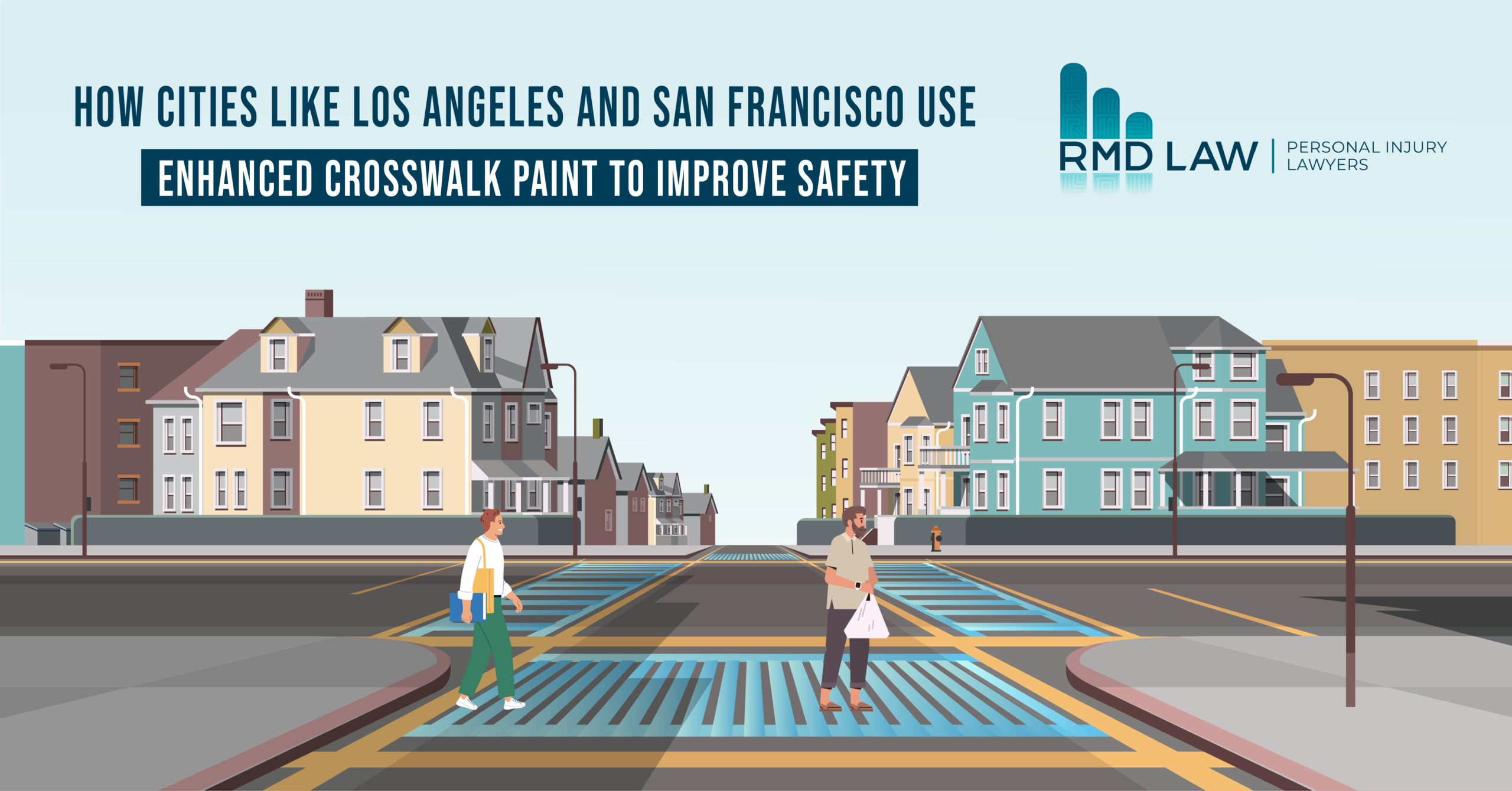
How Cities Like Los Angeles and San Francisco Use Enhanced Crosswalk Paint to Improve Safety
California’s busiest cities consistently rank among the most dangerous places in the US for pedestrians. In 2023, there were 1,106 pedestrian-related injuries and fatalities on California roadways, underscoring the high risk, even in areas with heavy foot traffic and updated safety features.
Traditional crosswalks often fail to catch a driver’s attention at night, in the rain, or in visually complex intersections. That’s why cities like Los Angeles and San Francisco have turned to enhanced crosswalk paint, reflective thermoplastics, LED-embedded markings, and bold “ladder” patterns to improve visibility and reduce crashes.
These innovations strengthen safety, but they can’t eliminate the dangers posed by negligent drivers. When a driver fails to yield—even in the most visible crosswalk—pedestrians still face severe injuries and long recovery times.
This article breaks down how high-visibility crosswalk designs work in Los Angeles and San Francisco, their measurable impact, their limitations, and why legal guidance remains essential after a pedestrian accident.
Innovative Crosswalk Strategies in Los Angeles and San Francisco
Cities across California are investing in brighter, more durable, and more visible crosswalks. These improvements help drivers identify pedestrian zones earlier and increase compliance at high-risk intersections.
Enhanced Crosswalk Safety in Los Angeles
Los Angeles continues to upgrade crosswalks in high-injury corridors as part of its Vision Zero program. These include school zones, nightlife districts like Hollywood, dense commercial streets, and intersections within the High Injury Network, where the majority of severe crashes occur.
High-visibility paint and materials
LA utilizes materials engineered to withstand heat, rain, and heavy vehicle flow. These high-visibility treatments enhance safety by providing clearer cues to drivers to slow down and yield, and they remain visible in both daytime glare and nighttime conditions.
Materials include:
- Reflective thermoplastic coatings: Durable material applied hot, containing glass beads to reflect light to the driver.
- Epoxy-based paints: A hard-wearing, long-lasting alternative to standard road paint.
- Textured or raised surfaces: These are often used as rumble strips or enhanced crosswalks to alert speeding drivers through vibration and noise.
- Targeted installation at high-risk locations
City planners use a data-driven approach to prioritize the installation of high-visibility materials and infrastructure where they prevent the most harm. They focus on:
- Multi-lane intersections with poor visibility
- School walking routes
- Commercial streets with heavy foot traffic
- Areas with historically high pedestrian-vehicle conflicts
By focusing on these hotspots, the city ensures its investment in paint and infrastructure is strategically placed for maximum safety impact.
Measurable impact on driver behavior
Federal Highway Administration (FHWA) studies show that enhanced pavement markings—especially high-visibility designs—can reduce nighttime crashes by 13–52% on certain roadways.
These markings help drivers decelerate earlier, yield to pedestrians more consistently, and approach intersections with greater caution. The impact is strongest at crossings with bold continental or ladder-striped patterns, particularly when paired with curb extensions, pedestrian islands, and other traffic-calming features.
Challenges and ongoing risks
Even the best crosswalks need regular maintenance, as the sun can fade markings, rain can reduce contrast, and glare can obscure reflective surfaces.
Most importantly, driver negligence—including speeding, distraction, and impaired driving—remains the major threat. This human factor is why many collision victims, even those in enhanced crosswalks, still need legal support to prove fault and seek fair compensation.

Enhanced Crosswalk Safety in San Francisco
San Francisco incorporates high-contrast crosswalks as part of its Vision Zero strategy, focusing on the High-Injury Network—a small percentage of streets where the most severe crashes occur. These improvements appear across downtown corridors, steep hill intersections, school zones, and tourist-heavy areas such as Market Street and Fisherman’s Wharf.
Advanced materials and patterns
San Francisco employs advanced materials and bold patterns to enhance pedestrian safety, particularly in challenging conditions like fog, nighttime, and steep intersections where driver visibility is reduced.
The city utilizes:
- Thermoplastic markings with reflective pigments: This durable material contains tiny glass beads that reflect vehicle headlights, greatly improving visibility.
- Bold ladder or zebra-style designs: These patterns create high-contrast visibility across the entire crossing area, making it clearer to drivers that they are approaching a crosswalk.
- Colored backgrounds for added contrast: Often bright green or yellow, these backgrounds make the white markings stand out against the grey asphalt.
- LED-embedded crosswalks in select high-risk areas: These add an active light source, providing an undeniable warning to approaching drivers.
- Strategic priority locations
San Francisco uses data to strategically prioritize crosswalk upgrades in locations where the risk of collision is highest.
Installation efforts concentrate on:
- Multi-lane arterials
- Transit-heavy corridors (where pedestrians frequently cross to catch buses or trains)
- Steep grades where driver sightlines are limited
- Tourist-dense blocks with unpredictable pedestrian movement
By focusing on these high-risk zones, the city ensures that every installation maximizes safety improvements.
Proven benefits for pedestrian safety
After the Safer Taylor Quick Build project, severe speeding dropped significantly: vehicles exceeding 30 mph decreased by 31%, and those over 40 mph fell by 94%. Studies show that drivers now slow earlier when approaching crosswalks, yield more consistently to pedestrians, and demonstrate greater awareness of crossing zones.
These safety gains are maximized when bold crosswalk designs are paired with physical infrastructure improvements—such as daylighting (removing parking near intersections) and curb extensions—which further enhance pedestrian visibility and protection.
Remaining risks despite improvements
Despite San Francisco’s infrastructural improvements, several factors continue to challenge pedestrian safety:
- Environmental obstacles: Natural conditions such as fog and uneven lighting, along with mechanical issues like malfunctioning LEDs and fading materials, can reduce crosswalk visibility.
- Urban complexity: Congested sidewalks and the city’s signature steep hills further complicate interactions between drivers and walkers by limiting sightlines and increasing maneuver time.
- Driver negligence: Even with the strongest infrastructure, driver negligence (speeding, distraction, etc.) remains a primary cause of many crosswalk collisions.
This persistent human factor underscores the ongoing need for legal protection in the event of accidents, despite the city’s best efforts to improve safety.

How RMD Law Helps Pedestrian Victims in Crosswalk Accidents
Even the most visible crosswalks cannot prevent every crash. When a driver fails to yield or violates a traffic law, pedestrians face serious injuries that require immediate legal support. RMD Law helps victims by:
1. Investigating the accident scene
When an accident occurs, we conduct a thorough investigation that goes beyond the basic police report. We analyze key elements, including traffic camera footage, police reports, lighting conditions, driver positioning, and crosswalk visibility.
At enhanced crosswalks, we specifically examine whether drivers ignored clear visual cues (such as high-contrast paint or flashing LEDs) or violated right-of-way laws.
2. Assessing driver negligence
We thoroughly evaluate the driver’s behavior to establish negligence, looking for specific violations and dangerous actions. It includes:
- Failure to yield at marked crosswalks
- Speeding through high-risk corridors
- Distracted or impaired driving
- Violations specific to school zones or Vision Zero areas
Furthermore, we address the legal concept of comparative negligence to ensure you are not unfairly blamed or penalized for a portion of the accident that was clearly the driver’s fault.
3. Documenting injuries and damages
Our team works to compile comprehensive documentation to build a full picture of your damages, which strengthens negotiations with insurers. This documentation includes medical records, rehabilitation costs, lost income, and long-term impacts (e.g., permanent disability, chronic pain).
This thorough approach ensures that the total value of your losses—both financial and non-financial—is accurately represented.
4. Handling insurance claims
Insurance companies frequently attempt to minimize liability by arguing that pedestrians “should have seen the car” or that busy intersections come with inherent risks.
We vigorously challenge these claims by presenting evidence gathered from the accident scene, visibility studies that counter the insurer’s narrative, and California pedestrian safety laws that establish the driver’s duty of care. This approach allows us to prove that the driver was at fault, even in complex or high-traffic areas.
5. Representing you in court
If the insurance company refuses to offer a fair settlement, we are prepared to pursue litigation. Our attorneys will fight aggressively in court to secure full compensation for all your losses, including medical bills and rehabilitation costs, lost earnings and diminished earning capacity, compensation for pain and suffering, and funding for future care needs.
Step Up Safety
High-visibility crosswalk paint and traffic-calming infrastructure make California streets safer, but they cannot fully protect pedestrians from negligent drivers.
If you were injured in a crosswalk—or any pedestrian zone—you must act quickly. A skilled pedestrian accident lawyer can immediately begin gathering evidence, navigating complex insurance challenges, and pursuing the compensation you deserve.
RMD Law is ready to protect your rights and guide you through every step of your recovery. Contact RMD Law today to discuss your legal options.
FAQs
Enhanced crosswalk paint uses reflective, high-contrast materials to increase visibility, especially at night or in poor weather.
LA focuses on high-risk intersections, school zones, nightlife areas, and busy commercial streets where pedestrian exposure is highest.
San Francisco uses ladder-style or zebra patterns, colored surfaces, and LED inserts to guide pedestrians safely across streets.
No. Enhanced crosswalks improve visibility and driver compliance, but accidents can still occur due to distracted, negligent, or impaired drivers.
An attorney can investigate collisions, collect evidence, and pursue compensation for medical bills, lost wages, and other damages.

- School Zone Pedestrian Accidents in California: Who’s Liable? - September 17, 2026
- Two Roads, 76 Deaths: New Data On Fresno County’s Most Dangerous Roads - September 15, 2026
- Why Wrong-Way Crashes Are Increasing in Orange County at Night - September 10, 2026